


Page 637 - The Book of Caterpillars: A Life-Size Guide to Six Hundred Species From Around the World
P. 637
MOTH CATERPILLARS

                      FAMILY  Noctuidae
                  DISTRIBUTION  Throughout Africa, Macaronesia, southernmost Europe
                           (rare migrant farther north to the British Isles), Madagascar,
                           the Middle East, and western Asia
                     HABITAT  Rain forests, moist tropical forests, and many open, warm habitats,
                           including farmland, rough ground, and gardens
                  HOST PLANTS  Many from more than 40 families, including Brassicaceae, such
                           as cabbage (Brassica spp.); Asteraceae, such as Lettuce (Lactuca
                           sativa); Fabaceae (legumes); Poaceae (grasses and cereals);
                           and Euphorbiaceae (spurges)

                      NOTE  Signi cant, mainly African pest that is variable but quite
                           distinctive
             CONSERVATION STATUS  Not evaluated, but widespread and common

                                                                                   ADULT WINGSPAN


                                                                                  1⅜–1 ⁄   in (35–40 mm)
                                                                                  CATERPILLAR LENGTH
                                                                                  1 ⁄  –1¾ in (40–45 mm)
            SPODOPTERA LITTORALIS
            AFRICAN COTTON LEAFWORM                                                              635

            (BOISDUVAL, 1833)


            The eggs of the African Cotton Leafworm, also known as the
            Mediterranean Brocade, are laid in batches of several hundred,
            covered with brownish hairs from the tip of the female’s
            abdomen. The caterpillar hides under a leaf when small, but
            when larger it may leave the plant to hide during the day.
            It feeds externally on the leaves, but on some hosts it also burrows
            into stems, such as Maize (Zea mays), or fruiting bodies, such
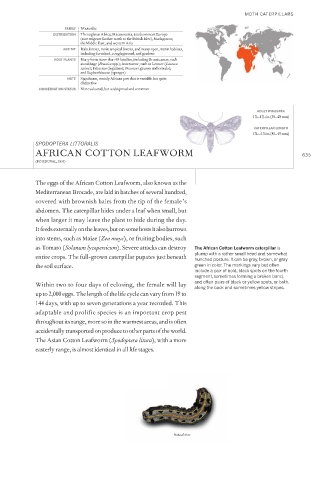
            as Tomato (Solanum lycopersicum). Severe attacks can destroy   The African Cotton Leafworm caterpillar is
            entire crops. The full-grown caterpillar pupates just beneath   plump with a rather small head and somewhat
                                                               hunched posture. It can be gray, brown, or gray
            the soil surface.                                  green in color. The markings vary but often
                                                               include a pair of bold, black spots on the fourth
                                                               segment, sometimes forming a broken band,
            Within two to four days of eclosing, the female will lay   and often pairs of black or yellow spots, or both,
                                                               along the back and sometimes yellow stripes.
            up to 2,000 eggs. The length of the life cycle can vary from 19 to
            144 days, with up to seven generations a year recorded. This
            adaptable and prolific species is an important crop pest
            throughout its range, more so in the warmest areas, and is often
            accidentally transported on produce to other parts of the world.
            The Asian Cotton Leafworm (Spodoptera litura), with a more
            easterly range, is almost identical in all life stages.


                                                        Actual size

