


Page 638 - The Book of Caterpillars: A Life-Size Guide to Six Hundred Species From Around the World
P. 638
MOTH CATERPILLARS

                                                     FAMILY  Noctuidae
                                                 DISTRIBUTION  Europe, including Portugal and northern Spain, southern
                                                          Scandinavia, and most of the Mediterranean; Asia Minor,
                                                          the Caucasus, and across central Asia to Korea and Japan
                                                    HABITAT  Open, rough vegetation in damp habitats, such as meadows
                                                          and  eld edges, woodland edges, and banks

                                                  HOST PLANTS  Herbaceous plants, mainly orache (Atriplex spp.), goosefoot
                                                          (Chenopodium spp.), knot-grass (Polygonum spp.), and dock
                                                          (Rumex spp.)
                                                      NOTE  Striped caterpillar that is distinguished by two yellow spots
                                             CONSERVATION STATUS  Not evaluated


            ADULT WINGSPAN
           1 ⁄  –2 in (40–50 mm)
           CATERPILLAR LENGTH
           1  ⁄  –1⅞ in (43–48 mm)
                                                                            TRACHEA ATRIPLICIS
                                                                   ORACHE MOTH
    636
                                                                                   (LINNAEUS, 1758)


                                            The Orache Moth caterpillar hatches from a pale, domed, ribbed
                                            egg and feeds on the leaves, in one generation. It develops
                                            through all instars from July to September. When small, it rests
                                            under a leaf of the food plant; at later instars, it hides close to the
                                            ground during the day, emerging to feed at night. When fully
                                            fed, the caterpillar forms a pupa in a cocoon in the ground, and
                                            this stage overwinters.


                                            Other noctuid caterpillars have markings that are broadly
                                            similar to those of the Orache Moth larvae. They include
                                            the Bright-line Brown-eye (Lacanobia oleracea) and Dog’s
                                            Tooth (L. suasa), which can also be found on plants of the
                                            Chenopodiaceae family in similar situations. However, despite
                                            its wide range of coloration, the Orache Moth caterpillar is easily
                                            distinguished by the pair of yellow spots situated dorsolaterally
                                            near the tail end and the yellow spots at the sides near the head.
                                            These pairs of spots are absent in Lacanobia species.


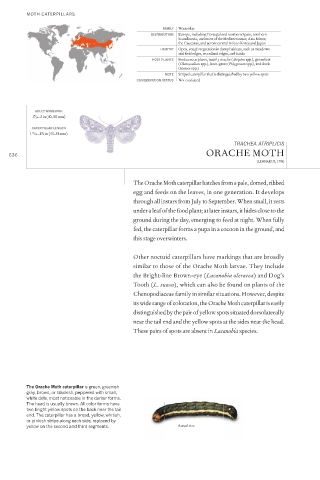
         The Orache Moth caterpillar is green, greenish
         gray, brown, or blackish, peppered with small,
         white dots, most noticeable in the darker forms.
         The head is usually brown. All color forms have
         two bright yellow spots on the back near the tail
         end. The caterpillar has a broad, yellow, whitish,
         or pinkish stripe along each side, replaced by
         yellow on the second and third segments.         Actual size

