


Page 636 - The Book of Caterpillars: A Life-Size Guide to Six Hundred Species From Around the World
P. 636
MOTH CATERPILLARS

                                                     FAMILY  Noctuidae
                                                 DISTRIBUTION  Southern United States, in California, and from Kentucky and
                                                          Maryland in the east, Oklahoma and Texas in the west, south to
                                                          the Caribbean, Central America, and South America to Argentina
                                                    HABITAT  Diverse, including agricultural land, woodlands, grasslands,
                                                          and wetlands
                                                  HOST PLANTS  Wide range of wild and cultivated plants, such as Sweet Potato
                                                          (Ipomoea batatas), and even chemically defended plants such
                                                          as rattlebox (Crotalaria spp.), greenbrier (Smilax spp.), and
                                                          nightshade (Solanum spp.); also, in Florida, recorded on a
                                                          semiaquatic plant, Dotted Knotweed (Persicaria punctata)
                                                      NOTE  Armyworm from a genus of highly destructive crop pests
                                             CONSERVATION STATUS  Not evaluated, but common


            ADULT WINGSPAN
             1 ⁄   in (40 mm)
           CATERPILLAR LENGTH
           1 ⁄  –2⅜ in (40–60 mm)
                                                                         SPODOPTERA DOLICHOS
                                             SWEET POTATO ARMYWORM
    634
                                                                                   (FABRICIUS, 1794)


                                            Sweet Potato Armyworm caterpillars hatch from as many
                                            as 4,000 eggs laid by a single female and feed on host plants
                                            from more than 40 families, illustrating their potential to be an
                                            explosive pest. However, their pest status is minor or negligible
                                            compared to some other species in the genus. The caterpillars are
                                            extensively parasitized by tachinid  ies, and, while their eyespots

                                            may scare some predators, their only other defense is to fall to
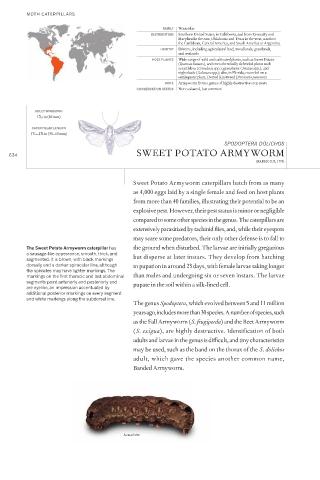
         The Sweet Potato Armyworm caterpillar has   the ground when disturbed. The larvae are initially gregarious
         a sausage-like appearance, smooth, thick, and   but disperse at later instars. They develop from hatching
         segmented. It is brown, with black markings
         dorsally and a darker spiracular line, although   to pupation in around 23 days, with female larvae taking longer
         the spiracles may have lighter markings. The
         markings on the   rst thoracic and last abdominal   than males and undergoing six or seven instars. The larvae
         segments point anteriorly and posteriorly and   pupate in the soil within a silk-lined cell.
         are eyelike, an impression accentuated by
         additional posterior markings on every segment
         and white markings along the subdorsal line.
                                            The genus Spodoptera, which evolved between 5 and 11 million
                                            years ago, includes more than 30 species. A number of species, such
                                            as the Fall Armyworm (S. frugiperda) and the Beet Armyworm
                                            (S. exigua), are highly destructive. Identification of both


                                            adults and larvae in the genus is di cult, and tiny characteristics
                                            may be used, such as the band on the thorax of the S. dolichos
                                            adult, which gave the species another common name,
                                            Banded Armyworm.


                                        Actual size

