


Page 14 - (DK) Eyewitness - Mars
P. 14
On the eve of the Space Age


        In the mid-20th century, science fiction
        about Mars was overtaken by scientific fact.
        Fast-developing technology gave scientists
        powerful telescopes, and new electronics offered
        long-distance communication at the speed of
        light. The study of light itself, “spectroscopy,”
        made it possible to analyze Martian minerals
        and the atmosphere. By the 1950s, average
        temperatures on Mars were found to be far               Detail from Antoniadi’s map
        colder than previously thought, and the
        air much thinner. Past reports of
        canals on Mars were considered by                             GERARD KUIPER (1905–1973)  EUGÉNE ANTONIADI (1870–1944)
                                                                      A leading 20th-century
                                                                                             This Turkish-born French
        many astronomers as “optical                                   astronomer, the Dutch-born   astronomer was at first convinced
        illusions” caused by inferior                                   Kuiper worked in America   Mars had canals. Then, in 1909,
                                                                                             he studied the planet through
                                                                        most of his career. In 1947,
        telescopes. Some questioned                                      he established that Martian   the 33-inch (83 cm) telescope
                                                                                             at Meudon Observatory near
                                                                         air contains carbon
        whether vegetation could grow                                    dioxide. Later research   Paris—Europe’s largest telescope.
                                                                         would prove carbon
        on the planet. Still, imaginative                                dioxide makes up 95   His maps of Mars showed streaks
                                                                                             and checkerboard patterns,
        artists pictured Mars with water                                percent of the atmosphere.  but no canals.
        and greenery, where human
                                                                                     Carbon dioxide is
                                                                                                          Earth’s atmospheric
        colonists could survive and work.                                           made up of 1 carbon   shimmering blurs image
        The truth about Mars was close at                                       atom and 2 oxygen atoms
        hand, however, as rocket scientists
        prepared spacecraft to blast off into
        the Space Age.


                                                                Geological
                                                                details unclear


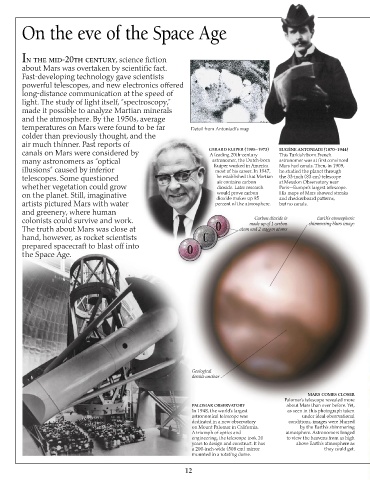
                                                                                                       MARS COMES CLOSER
                                                                                               Palomar’s telescope revealed more
                                                                PALOMAR OBSERVATORY             about Mars than ever before. Yet,
                                                                In 1948, the world’s largest    as seen in this photograph taken
                                                                astronomical telescope was           under ideal observational
                                                                dedicated in a new observatory   conditions, images were blurred
                                                                on Mount Palomar in California.     by the Earth’s shimmering
                                                                A triumph of optics and         atmosphere. Astronomers longed
                                                                engineering, the telescope took 20   to view the heavens from as high
                                                                years to design and construct. It has   above Earth’s atmosphere as
                                                                a 200-inch-wide (508 cm) mirror             they could get.
                                                                mounted in a rotating dome.

                                                              12

