


Page 42 - (DK) Eyewitness - Mars
P. 42
Volcanoes of Mars


                                       Volcanoes are vents that release melted rock, or magma, from
                                       underground. Magma rising through the mantle creates hot areas
                                       on the crust. Magma that breaks through the crust becomes lava.
                                       After flowing out of a volcano, lava cools and hardens, sometimes
                                       spreading hundreds of miles. Martian volcanoes once spewed out
                                       huge quantities of hot gas and water vapor, thickening the
                                       atmosphere. Clouds of cooling water vapor may have turned to
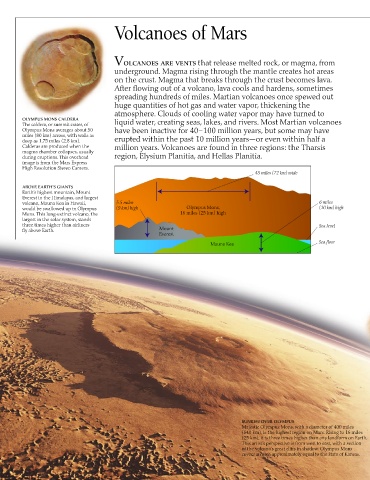
        OLYMPUS MONS CALDERA           liquid water, creating seas, lakes, and rivers. Most Martian volcanoes
        The caldera, or summit crater, of
        Olympus Mons averages about 50   have been inactive for 40–100 million years, but some may have
        miles (80 km) across, with walls as
        deep as 1.75 miles (2.8 km).   erupted within the past 10 million years—or even within half a
        Calderas are produced when the   million years. Volcanoes are found in three regions: the Tharsis
        magma chamber collapses, usually
        during eruptions. This overhead   region, Elysium Planitia, and Hellas Planitia.
        image is from the Mars Express
        High Resolution Stereo Camera.
                                                                                     45 miles (72 km) wide

        ABOVE EARTH’S GIANTS
        Earth’s highest mountain, Mount
        Everest in the Himalayas, and largest
        volcano, Mauna Kea in Hawaii,   5.5 miles                                                          6 miles
        would be swallowed up in Olympus   (9 km) high         Olympus Mons,                               (10 km) high
        Mons. This long-extinct volcano, the                 16 miles (25 km) high
        largest in the solar system, stands
        three times higher than airliners                                                                 Sea level
        fly above Earth.                              Mount
                                                      Everest
                                                                                                          Sea floor
                                                                       Mauna Kea


                                                                                 SUNRISE OVER OLYMPUS
                                                                                 Majestic Olympus Mons, with a diameter of 400 miles
                                                                                 (640 km), is the highest region on Mars. Rising to 16 miles
                                                                                 (25 km), it is three times higher than any landform on Earth.
                                                                                 This artist’s perspective is from west to east, with a section
                                                                                 of the volcano’s great cliffs in shadow. Olympus Mons
                                                                                 covers an area approximately equal to the state of Kansas.

