


Page 41 - (DK) Eyewitness - Mars
P. 41
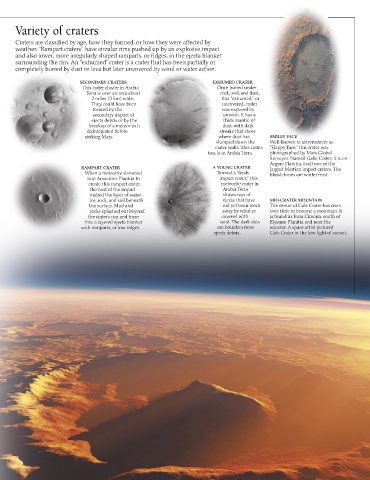
Variety of craters

      Craters are classified by age, how they formed, or how they were affected by
      weather. “Rampart craters’’ have circular rims pushed up by an explosive impact
      and also lower, more irregularly shaped ramparts, or ridges, in the ejecta blanket
      surrounding the rim. An “exhumed” crater is a crater that has been partially or
      completely buried by dust or lava but later uncovered by wind or water action.
                           SECONDARY CRATERS                           EXHUMED CRATER
                            This crater cluster in Arabia                Once buried under
                             Terra is over an area about                  rock, soil, and dust,
                               2 miles (3 km) wide.                       this “exhumed,” or
                               They could have been                       uncovered, crater
                                formed by the                             was exposed by
                                secondary impact of                        erosion. It has a
                               ejecta debris or by the                     thick mantle of
                              breakup of a meteor as it                    dust, with dark
                              disintegrated before                        streaks that show
                             striking Mars.                              where dust has   SMILEY FACE
                                                                        slumped down the   Well-known to astronomers as
                                                                        crater walls. This crater,   “Happy Face,” this crater was
                                                                      too, is in Arabia Terra.  photographed by Mars Global
                                                                                          Surveyor. Named Galle Crater, it is on
                                                                                          Argyre Planitia, itself one of the
                            RAMPART CRATER                             A YOUNG CRATER     largest Martian impact craters. The
                             When a meteorite slammed                    Termed a “fresh   bluish tones are winter frost.
                              into Amazonis Planitia to                   impact crater,” this
                              create this rampart crater,                 meteorite crater in
                               the heat of the impact                      Arabia Terra
                               melted the layer of water                   shows rays of
                               ice, rock, and soil beneath                 ejecta that have   MID-CRATER MOUNTAIN
                               the surface. Mud and                        not yet been worn   The center of Gale Crater has risen
                               rocks splashed out beyond                   away by wind or   over time to become a mountain. It
                              the crater’s rim and froze                  covered with    is found in Terra Cimeria, south of
                             into a layered ejecta blanket                sand. The dark dots   Elysium Planitia and near the
                            with ramparts, or low ridges.                are boulders from   equator. A space artist pictured
                                                                        ejecta debris.    Gale Crater in the low light of sunset.

