


Page 40 - (DK) Eyewitness - Mars
P. 40
Craters on Mars


                                                                    Over billions of years, comets,
                                                                    asteroids, and meteorites have crashed by
                                                                   the thousands onto the Martian surface.
                                                                   From space, the planet looks pocked and
                                                                   scarred. Unlike Earth, Mars does not have
                                                                   the thick, protective atmosphere that
                                                                  burns up most space rocks. They blaze
                                                                 down and blast the Martian surface,
                                                               creating “impact craters” that range from a
                                                            few yards to hundreds of miles across. Impact
                                                        craters have a circular ridge formed partly by debris
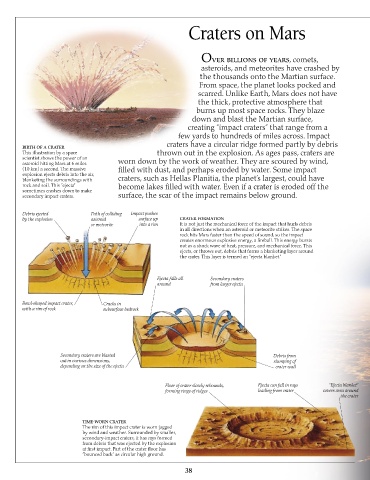
        BIRTH OF A CRATER
        This illustration by a space                 thrown out in the explosion. As ages pass, craters are
        scientist shows the power of an
        asteroid hitting Mars at 6 miles   worn down by the work of weather. They are scoured by wind,
        (10 km) a second. The massive   filled with dust, and perhaps eroded by water. Some impact
        explosion ejects debris into the air,
        blanketing the surroundings with   craters, such as Hellas Planitia, the planet’s largest, could have
        rock and soil. This “ejecta”    become lakes filled with water. Even if a crater is eroded off the
        sometimes crashes down to make
        secondary impact craters.       surface, the scar of the impact remains below ground.


        Debris ejected         Path of colliding   Impact pushes
        by the explosion       asteroid        surface up    CRATER FORMATION
                               or meteorite    into a rim    It is not just the mechanical force of the impact that hurls debris
                                                             in all directions when an asteroid or meteorite strikes. The space
                                                             rock hits Mars faster than the speed of sound, so the impact
                                                             creates enormous explosive energy, a fireball. This energy bursts
                                                             out as a shock wave of heat, pressure, and mechanical force. This
                                                             ejects, or throws out, debris that forms a blanketing layer around
                                                             the crater. This layer is termed an “ejecta blanket.”


                                                     Ejecta falls all   Secondary craters
                                                     around            from larger ejecta


        Bowl-shaped impact crater,   Cracks in
        with a rim of rock         subsurface bedrock


                     Secondary craters are blasted                                         Debris from
                     out in various dimensions,                                             slumping of
                     depending on the size of the ejecta                                    crater wall


                                                        Floor of crater slowly rebounds,   Ejecta can fall in rays   “Ejecta blanket”
                                                        forming rings of ridges       leading from crater   covers area around
                                                                                                                  the crater


                            TIME-WORN CRATER
                            The rim of this impact crater is worn jagged
                            by wind and weather. Surrounded by smaller,
                            secondary-impact craters, it has rays formed
                            from debris that was ejected by the explosion
                            at first impact. Part of the crater floor has
                            “bounced back” as circular high ground.

                                                              38

