


Page 54 - (DK) Eyewitness - Mars
P. 54
Mars rovers and Martian rocks


         NASA launched two Mars
         Exploration Rover spacecraft in mid-
         2003, each carrying identical rovers. The
         prime mission of these two “robotic field
         geologists,” as Spirit and Opportunity
         rovers were described, was to find signs of
         past water activity. Spirit arrived in Gusev
         Crater on January 4, 2004. Opportunity
         landed halfway around the Martian globe on
         Meridiani Planum on January 25. Equipment
         on their Instrument Deployment Devices—
         robotic arms—drilled rock and took the first-ever
         microscopic photographs on Mars. Each rover
         drove thousands of yards around its landing site.
         The search for evidence of water was a resounding                         LANDING SITE A DRY SEABED
         success, particularly with the discovery of                               Opportunity landed on Meridiani Planum, one
                                                                                   of the smoothest, flattest regions on Mars. This
         minerals that usually form in groundwater.                                high plain may once have been a shallow, salty
         Opportunity found sedimentary rock that had                               sea, as depicted in this painting.
         been laid down in liquid, probably water.
         Scientists are gaining confidence that Mars                                                Antennas
         could have once supported life.                      Cameras and

                                                              spectrometer                                  Solar array
         ROBOTIC GEOLOGISTS                                   on mast
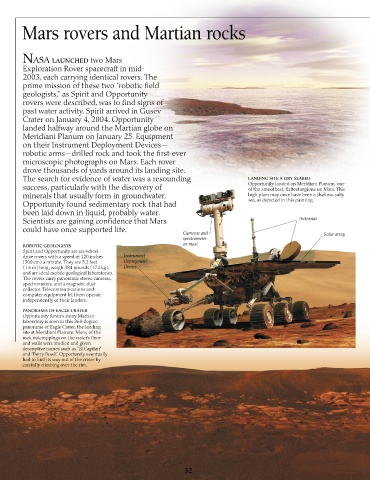
         Spirit and Opportunity are six-wheel-
         drive rovers with a speed of 120 inches   Instrument
         (300 cm) a minute. They are 5.2 feet   Deployment
         (1.6 m) long, weigh 384 pounds (174 kg),   Device
         and are ideal mobile geological laboratories.
         The rovers carry panoramic stereo cameras,
         spectrometers, and a magnetic dust
         collector. Telecommunications and
         computer equipment let them operate
         independently of their landers.

         PANORAMA OF EAGLE CRATER
         Opportunity Rover’s stony Martian
         laboratory is seen in this 360-degree
         panorama of Eagle Crater, the landing
         site at Meridiani Planum. Many of the
         rock outcroppings on the crater’s floor
         and walls were studied and given
         descriptive names such as “El Capitan”
         and “Berry Bowl.” Opportunity eventually
         had to find its way out of the crater by
         carefully climbing over the rim.


                                                              52

