


Page 56 - (DK) Eyewitness - Mars
P. 56
Unsuccessful missions


        In 1960, the Soviets launched Marsnick 1,
        mankind’s first probe to Mars. That probe
        failed, as did the next eight Soviet spacecraft.
        Their tenth launch achieved orbit, but its
        lander crashed. The Soviet program ended in
        1988 after three successes and 15 flops. The
        United States, on the other hand, launched
        16 Mars missions before 2004, with 11
        successes. Almost two-thirds of the first
        37 Mars missions—including one each by
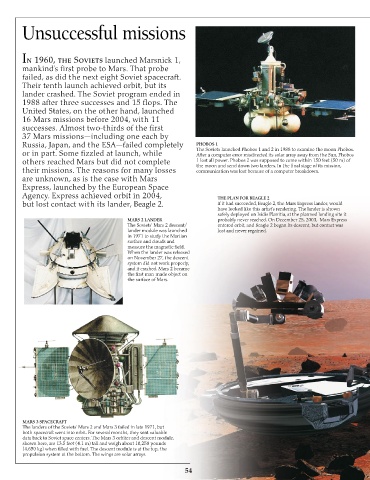
        Russia, Japan, and the ESA—failed completely              PHOBOS 1
        or in part. Some fizzled at launch, while                 The Soviets launched Phobos 1 and 2 in 1988 to examine the moon Phobos.
                                                                  After a computer error misdirected its solar array away from the Sun, Phobos
        others reached Mars but did not complete                  1 lost all power. Phobos 2 was supposed to come within 150 feet (50 m) of
                                                                  the moon and send down two landers. In the final stage of its mission,
        their missions. The reasons for many losses               communication was lost because of a computer breakdown.
        are unknown, as is the case with Mars
        Express, launched by the European Space
        Agency. Express achieved orbit in 2004,                          THE PLAN FOR BEAGLE 2
        but lost contact with its lander, Beagle 2.                      If it had succeeded, Beagle 2, the Mars Express lander, would
                                                                         have looked like this artist’s rendering. The lander is shown
                                                                         safely deployed on Isidis Planitia, at the planned landing site it
                                           MARS 2 LANDER                 probably never reached. On December 25, 2003,  Mars Express
                                           The Soviets’ Mars 2 descent/  entered orbit, and Beagle 2 began its descent, but contact was
                                           lander module was launched    lost and never regained.
                                           in 1971 to study the Martian
                                           surface and clouds and
                                           measure the magnetic field.
                                           When the lander was released
                                           on November 27, the descent
                                           system did not work properly,
                                           and it crashed. Mars 2 became
                                           the first man-made object on
                                           the surface of Mars.


        MARS 3 SPACECRAFT
        The landers of the Soviets’ Mars 2 and Mars 3 failed in late 1971, but
        both spacecraft went into orbit. For several months, they sent valuable
        data back to Soviet space centers. The Mars 3 orbiter and descent module,
        shown here, are 13.5 feet (4.1 m) tall and weigh about 10,250 pounds
        (4,650 kg) when filled with fuel. The descent module is at the top, the
        propulsion system at the bottom. The wings are solar arrays.

                                                              54

