


Page 72 - (DK) Eyewitness - Mars
P. 72
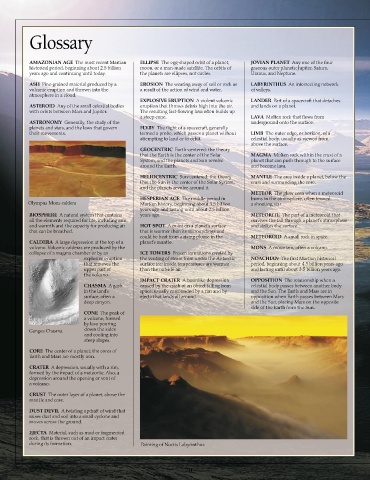
Glossary


           AMAZONIAN AGE  The most recent Martian   ELLIPSE  The egg-shaped orbit of a planet,   JOVIAN PLANET  Any one of the four
           historical period, beginning about 2.5 billion   moon, or a man-made satellite. The orbits of   gaseous outer planets: Jupiter, Saturn,
           years ago and continuing until today.  the planets are ellipses, not circles.  Uranus, and Neptune.

           ASH  Fine-grained material produced by a   EROSION  The wearing away of soil or rock as   LABYRINTHUS  An intersecting network
           volcanic eruption and thrown into the   a result of the action of wind and water.  of valleys.
           atmosphere in a cloud.
                                               EXPLOSIVE ERUPTION  A violent volcanic   LANDER  Part of a spacecraft that detaches
           ASTEROID  Any of the small celestial bodies   eruption that throws debris high into the air.   and lands on a planet.
           with orbits between Mars and Jupiter.  The resulting fast-flowing lava often builds up
                                               a steep cone.                        LAVA  Molten rock that flows from
           ASTRONOMY  Generally, the study of the                                   underground onto the surface.
           planets and stars, and the laws that govern   FLYBY  The flight of a spacecraft, generally
           their movements.                    termed a probe, which passes a planet without   LIMB  The outer edge, or horizon, of a
                                               attempting to land or to orbit.      celestial body, usually as viewed from
                                                                                    above the surface.
                                               GEOCENTRIC  Earth-centered: the theory
                                               that the Earth is the center of the Solar   MAGMA  Molten rock within the crust of a
                                               System, and the planets and Sun revolve   planet that can push through to the surface
                                               around the Earth.                    and become lava.
                                               HELIOCENTRIC  Sun-centered: the theory   MANTLE  The area inside a planet, below the
                                               that the Sun is the center of the Solar System,   crust and surrounding the core.
                                               and the planets revolve around it.
                                                                                    METEOR  The glow seen when a meteoroid
                                               HESPERIAN AGE  The middle period in   burns in the atmosphere, often termed
          Olympus Mons caldera                 Martian history, beginning about 3.5 billion   a shooting star.
                                               years ago and lasting until about 2.5 billion
           BIOSPHERE  A natural system that contains   years ago.                   METEORITE  The part of a meteoroid that
           all the elements required for life, including rain                       survives the fall through a planet’s atmosphere
           and warmth and the capacity for producing air   HOT SPOT  A point on a planet’s surface   and strikes the surface.
           that can be breathed.               that is warmer than its surroundings and
                                               could be heat from a rising plume in the   METEOROID  A small rock in space.
           CALDERA  A large depression at the top of a   planet’s mantle.
           volcano. Volcanic calderas are produced by the                           MONS  A mountain, often a volcano.
           collapse of a magma chamber or by an   ICE TOWERS  Frozen formations created by
                             explosive eruption   the venting of steam from under the Antarctic   NOACHIAN  The first Martian historical
                             that removes the   surface ice; inside temperatures are warmer   period, beginning about 4.5 billion years ago
                             upper part of     than the outside air.                and lasting until about 3.5 billion years ago.
                             the volcano.
                                               IMPACT CRATER  A basinlike depression   OPPOSITION  The relationship when a
                             CHASMA  A gash    caused by the crash of an object falling from   celestial body passes between another body
                             in the land’s     space; usually surrounded by a rim and by   and the Sun. The Earth and Mars are in
                             surface, often a   ejecta that lands all around.       opposition when Earth passes between Mars
                             deep canyon.                                           and the Sun, placing Mars on the opposite
                                                                                    side of the Earth from the Sun.
                             CONE  The peak of
                             a volcano, formed
                             by lava pouring
           Ganges Chasma     down the sides
                             and cooling into
                             steep slopes.
           CORE  The center of a planet; the cores of
           Earth and Mars are mostly iron.
           CRATER  A depression, usually with a rim,
           formed by the impact of a meteorite. Also, a
           depression around the opening or vent of
           a volcano.
           CRUST  The outer layer of a planet, above the
           mantle and core.
           DUST DEVIL  A twisting updraft of wind that
           raises dust and soil into a small cyclone and
           moves across the ground.

           EJECTA  Material, such as mud or fragmented
           rock, that is thrown out of an impact crater
           during its formation.                Painting of Noctis Labyrinthus


                                                               0

