


Page 71 - (DK) Eyewitness - Mars
P. 71
WATCHING MARS


          The best time to view the Red Planet is at                USEFUL WEBSITES
          opposition, when Mars and the Earth are nearest.
          This happens every two years—2005, 2007, etc.—            •  Smithsonian Institution’s National Air and Space Museum:
                                                                      www.nasm.si.edu
          during August or September. A moderately good             •  NASA’s Mars exploration program:
                                                                      http://mars.jpl.nasa.gov
          telescope can see the white polar caps in the             •  NASA’s archive at the National Space Science Data Center:
          north and south. The darker areas of the surface            http://nssdc.gsfc.nasa.gov/planetary/planets/marspage.html
          may look greenish. This is caused by the contrast         •  NASA’s guide to making your own 3-D glasses:
                                                                      www.nasa.gov/audience/forkids/activities/A_Make_3D_
          in color between the dark patches and the redder,           Glasses.html
          brighter areas. The best views of all are every 15        •  European Space Association:
                                                                      www.esa.int
          or 17 years, when the closest opposition occurs.          •  News and information on exploring Mars:
                                                                      www.exploringmars.com
                                                                    •  Shows how to analyze results from the Mars Exploration
                                                                      Rovers or design a manned mission to Mars:
                                                                      www.marsacademy.com
                                                                    •  Current news, articles, and images about Mars exploration:
                                                                      www.marsnews.com
                                                                    •  Mars Society Organization:
                                                                      www.marssociety.org
                                                                    •  Malin Space Science Systems:
                                                                      www.msss.com
                                                                    •  History, mythology, and the science of our Solar System:
                                                                      www.nineplanets.org
                                                                    •  Planetary Society:
                                                                      www.planetary.org
                                                                    •  Current news on space missions:
                                                                      www.rednova.com
                                                                    •  Students for the exploration and development of space:
                                                                      www.seds.org
                                                                    •  History of space exploration:
                                                                      www.solarviews.com
                                                                    •  Current news and articles:
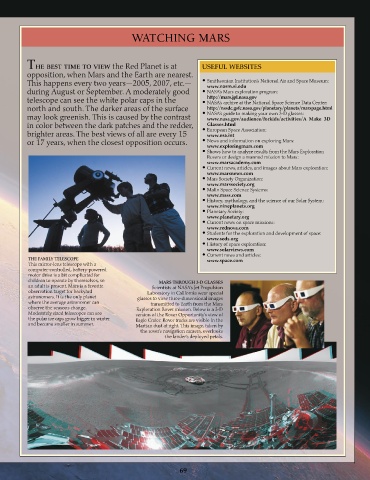
          THE FAMILY TELESCOPE                                        www.space.com
          This mirror-lens telescope with a
          computer-controlled, battery-powered
          motor drive is a bit complicated for
          children to operate by themselves, so       MARS THROUGH 3-D GLASSES
          an adult is present. Mars is a favorite   Scientists at NASA’s Jet Propulsion
          observation target for backyard         Laboratory in California wear special
          astronomers. It is the only planet   glasses to view three-dimensional images
          where the average astronomer can         transmitted to Earth from the Mars
          observe the seasons change.         Exploration Rover mission. Below is a 3-D
          Moderately sized telescopes can see   version of the Rover Opportunity’s view of
          the polar ice caps grow bigger in winter   Eagle Crater. Rover tracks are visible in the
          and become smaller in summer.       Martian dust at right. This image, taken by
                                               the rover’s navigation camera, overlooks
                                                        the lander’s deployed petals.

