


Page 68 - (DK) Eyewitness - Mars
P. 68
Timeline


            Wise men of ancient days observed the
            heavens and gave meaning and names to
            what they saw. They passed on their
            knowledge to philosopher-scientists such as
            Aristotle and Ptolemy. The works of these
            men, in turn, were studied by Copernicus
            and others who developed new ideas. Next,
            telescopes brought the stars and planets
            closer, and scientists searched Mars for signs
            of life. Popular culture turned scientific theory
            into stories of high adventure, inspiring young
            people to become astronomers and learn more
            about their universe, Solar System, and Mars. Science
            fiction became reality in the 1960s, when an American
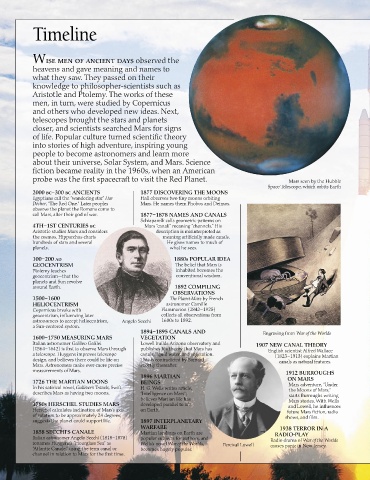
            probe was the first spacecraft to visit the Red Planet.                              Mars seen by the Hubble
                                                                                          Space Telescope, which orbits Earth
            2000 bc–300 bc ANCIENTS             1    DISCOVERING THE MOONS
            Egyptians call the “wandering star” Har   Hall observes two tiny moons orbiting
            Décher, “The Red One.” Later peoples   Mars. He names them Phobos and Deimos.
            observe the planet the Romans come to
            call Mars, after their god of war.  1877–1878 NAMES AND CANALS
                                                Schiaparelli calls geometric patterns on
            4TH–1ST CENTURIES bc                 Mars “canali” meaning “channels.” His
            Aristotle studies Mars and considers     description is misinterpreted as
            the cosmos. Hipparchus charts              meaning artificially made canals.
            hundreds of stars and several               He gives names to much of
            planets.                                     what he sees.
            100–200 ad                                     1  0s POPULAR IDEA
            GEOCENTRISM                                    The belief that Mars is
            Ptolemy teaches                                inhabited becomes the
            geocentrism—that the                           conventional wisdom.
            planets and Sun revolve
            around Earth.                                  1  2 COMPILING
                                                          OBSERVATIONS
            1500–1600                                    The Planet Mars by French
            HELIOCENTRISM                               astronomer Camille
            Copernicus breaks with                    Flammarion (1842–1925)
            geocentrism, influencing later            collects all observations from
            astronomers to accept heliocentrism,   Angelo Secchi  1600s to 1892.
            a Sun-centered system.
                                                1894–1895 CANALS AND                    Engraving from War of the Worlds
            1600–1750 MEASURING MARS            VEGETATION
            Italian astronomer Galileo Galilei    Lowell builds Arizona observatory and   1 0  NEW CANAL THEORY
            (1564–1642) is first to observe Mars through   publishes his theory that Mars has   English scientist Alfred Wallace
            a telescope. Huygens improves telescope   canals, liquid water, and vegetation.   (1823–1913) explains Martian
            design, and believes there could be life on   This is contradicted by Barnard    canals as natural features.
            Mars. Astronomers make ever-more precise   shortly thereafter.
            measurements of Mars.                                                               1 12 BURROUGHS
                                                1    MARTIAN                                    ON MARS
            1 2  THE MARTIAN MOONS              BEINGS                                           Mars adventure, “Under
            In his satirical novel, Gulliver’s Travels, Swift   H. G. Wells writes article,      the Moons of Mars,”
            describes Mars as having two moons.  “Intelligence on Mars”;                         starts Burroughs writing
                                                believes Martian life has                        Mars stories. With Wells
            1  0s HERSCHEL STUDIES MARS         developed parallel to life                      and Lowell, he influences
            Herschel calculates inclination of Mars’s axis   on Earth.                          future Mars fiction, radio
            of rotation to be approximately 24 degrees;                                        shows, and film.
            suggests the planet could support life.  1    INTERPLANETARY
                                                WARFARE                                       1938 TERROR IN A
            1 5  SECCHI’S CANALE                Martian landings on Earth are               RADIO-PLAY
            Italian astronomer Angelo Secchi (1818–1878)   popular subjects for authors, and   Radio drama of War of the Worlds
            renames Huygens’s “Hourglass Sea” as   Wells’s novel War of the Worlds,   Percival Lowell  causes panic in New Jersey.
            “Atlantic Canale,” using the term canal or   becomes hugely popular.
            channel in relation to Mars for the first time.

