


Page 67 - (DK) Eyewitness - Mars
P. 67
QUESTIONS AND ANSWERS


              Do the two Martian moons orbit                                          Why search for information about
           Qin the same direction?                                                Qpast Martian weather?

              Yes, but it does not look that way .                                   Understanding the past climate of
           Afrom Mars. Phobos and Deimos seem                                     AMars could help scientists discover
           to go in opposite directions. Phobos orbits                            whether the planet supported life. Part of
           the planet three times for every revolution                            the mission of NASA’s Mars Climate
           of Mars—a Martian day. Seen from Mars,                                 Orbiter, launched in 1998, was to look for
           Phobos rises in the West and sets in the                               clues about past Martian climates and how
           East. Deimos takes three days to complete                              they changed. The spacecraft
           an orbit, rising in the East and setting in                            unfortunately crashed on its approach.
           the West.

              How often do Mars and Earth come   Japanese orbiter, Nozomi
           Qnearest to each other?
              On August 27, 2003, Mars made its   Have only the U.S. and European
           Aclosest approach to Earth in nearly   Qspace programs sent spacecraft close
           60,000 years. The distance between the   to Mars in recent years?
           planets then was approximately 34.6 million
           miles (55.7 million km). The last time Mars
           came so close was in 57,617 bc!       No, NASA and the European Space
                                              AAgency are now joined by the Japanese
                                              space program. The Japanese launched
           Q  Who named Olympus Mons?         Nozomi in 1998, but the spacecraft ran low
                                              on fuel. Unable to complete its objectives,
                                              Nozomi passed within 625 miles (1,000 km)
              Italian astronomer Giovanni     of Mars and kept going. The craft was
           ASchiaparelli gave this shield volcano   reprogrammed to orbit the Sun.
           the name Nix Olympicus—the “Snows of
           Olympus.” It appeared in his telescope as a   Q Did Mars ever have much water?
           white area in the orange Martian surface.
           Schiaparelli named it after Mount
           Olympus, mythical home of the Greek   There is evidence that Mars had liquid
           gods. In 1971, images from Mariner 9   Awater, water ice, and water vapor until
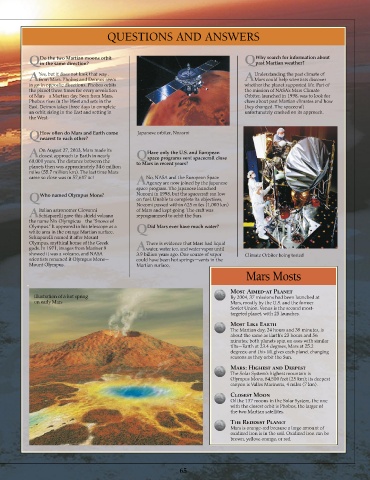
           showed it was a volcano, and NASA   3.9 billion years ago. One source of vapor   Climate Orbiter being tested
           scientists renamed it Olympus Mons—   could have been hot springs—vents in the
           Mount Olympus.                     Martian surface.
                                                                                   Mars Mosts


                                                                             Most Aimed-at Planet
            Illustration of a hot spring                                     By 2004, 37 missions had been launched at
            on early Mars                                                    Mars, mostly by the U.S. and the former
                                                                             Soviet Union. Venus is the second most-
                                                                             targeted planet, with 25 launches.
                                                                             Most Like Earth
                                                                             The Martian day, 24 hours and 39 minutes, is
                                                                             about the same as Earth’s 23 hours and 56
                                                                             minutes; both planets spin on axes with similar
                                                                             tilts—Earth at 23.4 degrees, Mars at 25.2
                                                                             degrees; and this tilt gives each planet changing
                                                                             seasons as they orbit the Sun.
                                                                             Mars: Highest and Deepest
                                                                             The Solar System’s highest mountain is
                                                                             Olympus Mons, 84,500 feet (25 km); its deepest
                                                                             canyon is Valles Marineris, 4 miles (7 km).
                                                                             Closest Moon
                                                                             Of the 137 moons in the Solar System, the one
                                                                             with the closest orbit is Phobos, the larger of
                                                                             the two Martian satellites.
                                                                             The Reddest Planet
                                                                             Mars is orange-red because a large amount of
                                                                             oxidized iron is in the soil. Oxidized iron can be
                                                                             brown, yellow, orange, or red.


                                                             5

