


Page 47 - BBC Wildlife Volume 36 #11
P. 47
CHURCHYARD WILDLIFE


                                                                Just as in any other                                               a maverick zeal can cause
                                                              habitat, the types of plants                                         more harm than good
                                                              and other organisms that                                             and result in a wilderness
                                                              populate and thrive in                                               rather than a wildlife
                                                              churchyards are dependent                                           reserve. So, how should
                                                              on the nature of the soil – wet                                   a potential churchyard
                                                              or dry, acidic or alkaline, and                                 conservation group begin its
                                                              so on – as well as the prevailing                            activities, and avoid the pitfalls?
                                                              climate and aspect. But there is another
                                                              important characteristic in the structure of the   Dos and don’ts
                                                              church building and the type of gravestones.     It is essential, as well as courteous, to sound
                                                              Ancient churches were usually built using        out the views of the parish priest and the
                                                              the most conveniently available local building   parish authorities on your intentions and to
                                                              stone, mainly because of the impracticality of   seek the comments of fellow parishioners.
                                                              transporting stone from distant quarries along   Strange as it may seem for those committed to
                                                              the rough tracks in the Middle Ages. While       wildlife and conservation, some people prefer
                                                              this is significant for the overall appearance    closely mown, neatly maintained, almost
                                                              of the building and its blending into the        sanitised churchyards, so careful explanations
                                                              landscape, the type of stone used has indirect   and justification may be needed.
                                                              but important implications for wildlife, too.       Next investigate what information is
                                                                If the church is built of fairly soft, easily   available about the churchyard in times past,
                                                              worked stone like some sandstones and            using old photos and archived documents.
                                                              limestones, for example, it will weather         Follow this with a detailed survey of the plant
                                                              quickly and so provide tiny crannies and         and, if possible, the animal life already present
                                                              ledges on which plants and small creatures       in the churchyard. There may be experienced
                                                              may become established. Hard granites and        naturalists living in the parish who can help,
                                                              grits by contrast are more difficult to work but   but almost certainly outside guidance will be
                                                              retain their form for much longer and so have    needed and your county Wildlife Trust should
                                                              fewer of these wildlife-friendly little niches.  be the first choice. They can call on county
                                                                                                               specialists in the identification of most of the
                                                              Dedicated parishioners                           important natural-history groups – plants,
                                                              For years, small groups of parishioners have     birds, insects, lichens, and so forth.
                                                              recognised the importance of churchyards            Given this information about your
                                                              as habitats and have sought to limit the         churchyard’s wildlife, a management plan
                                                              impact of activities such as grass mowing and    should then be prepared – and again, expert
                                                              chemical use. In recent times, appreciation      help will be needed. But remember three
                                                              of the wildlife importance of churchyards        things. First, churchyards are above all burial
                                                              has become more widespread and better            grounds – the sanctity of the graves and the
                                                              organised. Today, around 6,000 churchyards       sensitivities of living relatives must be taken
                                                              are managed to some degree for their natural-    into account. Second, churchyard conservation
                                                              history value, with a few designated as Sites    and management is not gardening – it is
                                                              of Special Scientific Interest (SSSIs), which     the protection and enhancement of what
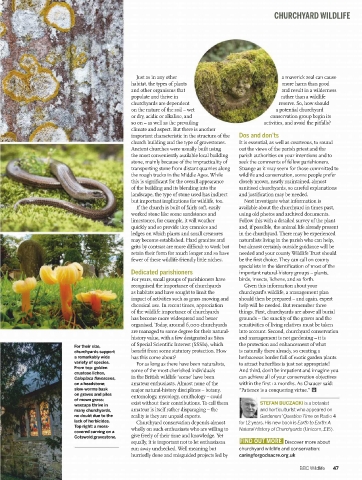
                                   For their size,
                                   churchyards support        benefit from some statutory protection. How       is naturally there already, so creating a
                                   a remarkably wide          has this come about?                             herbaceous border full of exotic garden plants
                                   variety of species.          For as long as there have been naturalists,    to attract butterflies is just not appropriate!
                                   From top: golden           some of the most cherished individuals           And third, don’t be impatient and imagine you
                                   crustose lichen,
                                   Caloplaca flavescens,       in the British wildlife ‘scene’ have been        can achieve all of your conservation objectives
                                   on a headstone;            amateur enthusiasts. Almost none of the          within the first 12 months. As Chaucer said:
                                   slow-worms bask            major natural-history disciplines – botany,      “Patience is a conquering virtue.”
                                   on graves and piles        entomology, mycology, ornithology – could
                                   of mown grass;
                                   waxcaps thrive in          exist without their contributions. To call them            STEFAN BUCZACKI is a botanist
                                   many churchyards,          amateur is itself rather disparaging – the                 and horticulturlst who appeared on
                                   no doubt due to the        reality is they are unpaid experts.                        Gardeners’Question Time on Radio 4
                                   lack of herbicides.          Churchyard conservation depends almost         for 12 years. His new book is Earth to Earth: A
                                   Top right: a moss-         wholly on such enthusiasts who are willing to    Natural History of Churchyards (Unicorn, £15).
                                   covered carving on a
                                   Cotswold gravestone.       give freely of their time and knowledge. Yet
                                                              equally, it is important not to let enthusiasm    FIND OUT MORE Discover more about
                                                              run away unchecked. Well meaning but             churchyard wildlife and conservation:
                                                              hurriedly done and misguided projects led by     caringforgodsacre.org.uk


                                                                                                                                           BBC Wildlife    47

