


Page 103 - (DK Eyewitness) Travel Guide - Mallorca, Menorca & Ibiza
P. 103
M AÓ 101
At the north corner of the square
stands the medieval Portal de Mayonnaise
Sant Roc which is named after Following his victory over the
Saint Roch, a 14th-century British, Louis-François-Armand
hermit who was believed to de Vignerot du Plessis, a cousin
be able to ward off the plague. of Cardinal Richelieu, stopped at
Flanked by bulky twin turrets a local inn where he was served
and a connecting arch, it is one a tasty sauce. On his return to
of the few remaining fragments Paris, he introduced the sauce to
of Maó’s medieval walls and the royal court, where the new
was once the exit point from garnish was an instant hit. Already
the city onto the road leading known on the islands as salsa
mahonesa, it became known in France as mayonnaise.
to Alaior. The fortifications did
not stop Barbarossa from
plundering the town, which P Ateneu Científic Literari i Environs
he took in 1535, destroying Artístic de Maó About 2 km (1 mile) east of
most of the city’s defences. Rovellada de Dalt 25. Tel 971 360 Maó, on the opposite side
553. Open 4–9:30pm Mon–Fri. of the bay, are two swanky
Closed Sat. suburbs – Sant Antoni and
Menorca’s Centre of Culture Cala Llonga. A short distance
and Science has a collection further, at the end of the
of local ceramics, natural hist- headland, stands the vast
ory exhibits (shells, birds, etc.), La Mola fortress, guarding the
maps and charts, a library entrance to the inlet. During
and permanent exhibitions the days of Franco it was used
of works by Spanish artists as a jail for political prisoners.
Pasqual Calbó, Màrius Verdaguer Near Sant Antoni is the
and Juan Vives Llull. stately home of Golden Farm
– a beautiful example of
R Sant Antoni Abat Menorcan Palladian archi-
Avinguda Vives Llull 15. Tel 971 350 tecture. Admiral Nelson is
636. Open 6–9pm Mon–Fri. reputed to have first met his
The 17th-century church of mistress Lady Hamilton here,
Portal de Sant Roc, viewed from the street St Anthony was closed after it although this is unlikely. Inside
leading to the town hall was pillaged during the Civil is a collection of mementos
War. Following its restoration, associated with the couple
P Plaça Esplanada it is now a venue for cultural and an extensive library. The
Plaça Esplanada, with its flower- events and exhibitions held by house is not open to the public.
beds shaded by pine trees, is the Sa Nosta Foundation. Es Murtar, 9 km (6 miles)
the biggest square in the to the northeast, is a charming
city and was once used as a Y Es Freginal village of white houses
military parade ground. Now, The park is a green oasis in standing at the foot of a
it provides a popular meeting the middle of town. During rocky crag, on the shores
place for the locals, especially high season it serves as a of a bay. Neighbouring Sa
at the weekends. The ice-cream venue for nightly cultural Mesquida lies further along
sellers and swings make events. It also provides a stage this rocky shoreline. The
it equally popular with for musicians taking part in village is dominated by a
local children. There is a the annual jazz festival. well-preserved watchtower.
market on Tuesday and
Saturday mornings.
The square is flanked on
three sides by low buildings,
many of them housing bars,
cafés and restaurants. The
western section of the square
features a huge Civil War
memorial erected during the
days of Franco. At the back of
the square are army barracks
built during the first British
occupation of the island and
now used by the Spanish Army.
Buses on their way to other
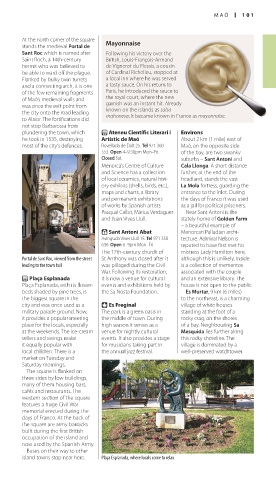
island towns stop near here. Plaça Esplanada, where locals come to relax
100-101_EW_Mallorca.indd 101 06/10/17 11:08 am

