


Page 105 - (DK Eyewitness) Travel Guide - Mallorca, Menorca & Ibiza
P. 105
MENORC A 103
Prehistoric Menorca
Menorca is exceptionally rich in megalithic structures. Most of the remains date from
the Talayotic period – a civilization that flourished between 1500 and 123 BC. The
period derives its name from the talayots (from atalaya, the Arabic word for a watch-
tower), the stone structures that are dotted around the island, mostly in former
settlements. There are various theories as to what their original purpose was –
they may have been used as defensive towers, burial sites or storehouses.
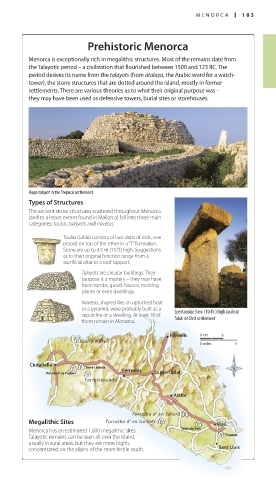
Huge talayot in the Trepucó settlement
Types of Structures
The ancient stone structures scattered throughout Menorca
(and to a lesser extent found in Mallorca) fall into three main
categories: taulas, talayots and navetas.
Taulas (table) consists of two slabs of rock, one
placed on top of the other in a “T” formation.
Some are up to 4.5 m (15 ft) high. Suggestions
as to their original function range from a
sacrificial altar to a roof support.
Talayots are circular buildings. Their
purpose is a mystery – they may have
been tombs, guard-houses, meeting
places or even dwellings.
Navetas, shaped like an upturned boat
or a pyramid, were probably built as a Spectacular 3-m- (10-ft-) high taula at
sepulchre or a dwelling. At least 10 of Talati de Dalt settlement
them remain in Menorca.
Fornells 0 km 5
Calla Morell
0 miles 5
Ciutadella Torre LIafuda
Naveta d’ es Tudons Ferreries Es Mercadal
Torretrencada
Alaior
Torralba d’ en Salord
Megalithic Sites Torralba d’ en Galmés Maó
Menorca has an estimated 1,600 megalithic sites. Talati de Dalt
Talayotic remains can be seen all over the island, Trepucó
usually in rural areas, but they are more highly
concentrated on the plains of the more fertile south. Sant LIuis
102-103_EW_Mallorca.indd 103 06/10/17 11:08 am

