


Page 104 - (DK Eyewitness) Travel Guide - Mallorca, Menorca & Ibiza
P. 104
102 THE BALEARIC ISLANDS AREA B Y AREA MENORC A 103
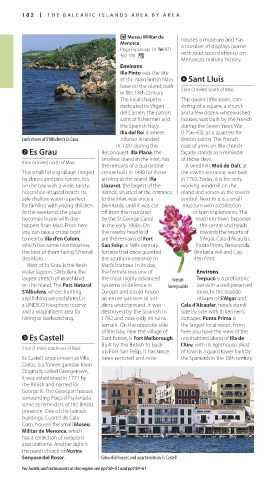
E Museu Militar de houses a museum and has
Menorca Prehistoric Menorca
Plaça Esplanada 19. Tel 971 a number of displays (some
362 100. & with loud sound effects) on
Menorca’s military history. Menorca is exceptionally rich in megalithic structures. Most of the remains date from
Environs the Talayotic period – a civilization that flourished between 1500 and 123 BC. The
Illa Pinto was the site period derives its name from the talayots (from atalaya, the Arabic word for a watch-
of the main British Navy 4 Sant Lluís tower), the stone structures that are dotted around the island, mostly in former
base on the island, built 5 km (3 miles) south of Maó.
in the 18th century. settlements. There are various theories as to what their original purpose was –
The local chapel is This quaint little town, con they may have been used as defensive towers, burial sites or storehouses.
dedicated to Virgen sisting of a square, a church
del Camen, the patron and a few dozen whitewashed
saint of fishermen and houses, was built by the French
the Spanish Navy. during the Seven Years’ War
Illa del Rei is where (1756–63), as a quarters for
Lush shores of S’Albufera’s Es Grau Alfonso III landed Breton sailors. The French
in 1287 during the coat of arms on the church
2 Es Grau Reconquest. Illa Plana, the façade stands as a reminder
smallest island in the inlet, has of those days.
6 km (4 miles) north of Maó.
the remains of a quarantine A windmill, Moli de Dalt, at
This small fishing village, fringed centre built in 1490 for those the town’s entrance, was built
by dunes and pine forests, lies arriving at the island. Illa in 1762. Today, it is the only
on the bay with a wide, sandy, Llazaret, the largest of the working windmill on the
horseshoeshaped beach. Its islands, situated at the entrance island and serves as the town’s Huge talayot in the Trepucó settlement
safe shallow water is perfect to the inlet, was once a symbol. Next to it is a small
for families with young children. peninsula, until it was cut museum with a collection Types of Structures
At the weekend, the place off from the mainland of farm implements. The The ancient stone structures scattered throughout Menorca
becomes busier with day by the St George Canal road into town bypasses (and to a lesser extent found in Mallorca) fall into three main
trippers from Maó. From here in the early 1900s. On the centre and heads categories: taulas, talayots and navetas.
you can take a cruise boat the nearby headland towards the resorts of
to nearby Illa d’en Colom, are the remains of Fort S’Algar, Cala d’Alcaufar, Taulas (table) consists of two slabs of rock, one
which has some nice beaches, San Felip, a 16thcentury Punta Prima, Biniancolla, placed on top of the other in a “T” formation.
the best of them being S’Arenal fortress that once guarded Binibeca Vell and Cap Some are up to 4.5 m (15 ft) high. Suggestions
des Moro. the southern entrance to d’en Font. as to their original function range from a
sacrificial altar to a roof support.
West of Es Grau is the fresh Maó’s harbour. In its day,
water lagoon, S’Albufera, the the fortress was one of Environs Talayots are circular buildings. Their
largest stretch of marshland the most highly advanced French Trepucó is a prehistoric purpose is a mystery – they may have
on the island. The Parc Natural systems of defence in honeysuckle site with a wellpreserved been tombs, guard-houses, meeting
S’Albufera, where hunting Europe and could house taula. In the seaside places or even dwellings.
and fishing are prohibited, is an entire garrison of sol villages of S’Algar and
a UNESCO biosphere reserve diers underground. It was Cala d’Al caufar, hotels stand Navetas, shaped like an upturned boat
and a magnificent area for destroyed by the Spanish in side by side with fishermen’s or a pyramid, were probably built as a Spectacular 3-m- (10-ft-) high taula at
sepulchre or a dwelling. At least 10 of
hiking or birdwatching. 1782 and now only its ruins cottages. Punta Prima is them remain in Menorca. Talati de Dalt settlement
remain. On the opposite side the largest local resort. From
of the bay, near the village of here you have the view of the
3 Es Castell Sant Esteve, is Fort Malborough. uninhabited island of Illa de Calla Morell Fornells 0 km 5
Built by the British to back l’Aire, with its lighthouse. West 0 miles 5
2 km (1 mile) southeast of Maó.
up Fort San Felip, it has since of town is a guard tower built by
Es Castell, once known as Villa been restored and now the Spaniards in the 18th century.
Carlos, is a former garrison town. Ciutadella Torre LIafuda
Originally called Georgetown, Naveta d’ es Tudons Ferreries Es Mercadal
it was established in 1771 by Torretrencada
the British and named for
George III. The Georgian houses
surrounding Plaça d’Esplanada Alaior
serve as reminders of the British
presence. One of the barrack Torralba d’ en Salord
buildings, Cuartel de Cala Torralba d’ en Galmés
Corp, houses the small Museu Megalithic Sites Maó
Militar de Menorca, which Menorca has an estimated 1,600 megalithic sites. Talati de Dalt
has a collec tion of weapons Talayotic remains can be seen all over the island, Trepucó
and uniforms. Another sight is usually in rural areas, but they are more highly Sant LIuis
the parish church of Nostra concentrated on the plains of the more fertile south.
Senyora del Roser. Colourful houses and apartments in Es Castell
For hotels and restaurants in this region see pp150–51 and pp159–61
102-103_EW_Mallorca.indd 102 06/10/17 11:08 am 102-103_EW_Mallorca.indd 103 06/10/17 11:08 am
Eyewitness Travel LAYERS PRINTED:
Catalogue template “UK” LAYER
(Source v2.4)
Date 25th April 2013
Size 125mm x 217mm

