


Page 28 - (DK Eyewitness) Travel Guide - England's South Coast
P. 28
26 INTRODUCING ENGLAND ’ S SOUTH C O AST
Coastal Wildlife
England’s long and varied southern coastline – ranging from
the stark granite cliffs of Land’s End to the coastal marshes of
North Kent – is matched by an equally diverse range of wildlife.
Beaches are covered with the colourful shells of molluscs,
while rock pools form miniature marine habitats teeming with
life. Caves are used by larger creatures, such as grey seals,
and cliffs provide nesting sites for birds. In the spring and
early summer, an astonishing variety of plants grow on the
foreshore and cliffs, seen at their best from one of the National
Trails, such as the South West Coast Path. The plants in turn
attract many moths and butterflies.
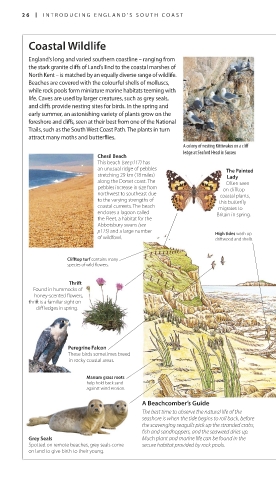
A colony of nesting Kittiwakes on a cliff
ledge at Seaford Head in Sussex
Chesil Beach
This beach (see p117) has
an unusual ridge of pebbles The Painted
stretching 29 km (18 miles) Lady
along the Dorset coast. The Often seen
pebbles increase in size from on clifftop
northwest to southeast due coastal plants,
to the varying strengths of this butterfly
coastal currents. The beach migrates to
encloses a lagoon called Britain in spring.
the Fleet, a habitat for the
Abbotsbury swans (see
p115) and a large number High tides wash up
of wildfowl. driftwood and shells.
Clifftop turf contains many
species of wild flowers.
Thrift
Found in hummocks of
honey-scented flowers,
thrift is a familiar sight on
cliff ledges in spring.
Peregrine Falcon
These birds sometimes breed
in rocky coastal areas.
Marram grass roots
help hold back sand
against wind erosion.
A Beachcomber’s Guide
The best time to observe the natural life of the
seashore is when the tide begins to roll back, before
the scavenging seagulls pick up the stranded crabs,
fish and sandhoppers, and the seaweed dries up.
Grey Seals Much plant and marine life can be found in the
Spotted on remote beaches, grey seals come secure habitat provided by rock pools.
on land to give birth to their young.
026-027_EW_ESC.indd 26 10/03/17 6:51 pm

