


Page 29 - (DK Eyewitness) Travel Guide - England's South Coast
P. 29
A POR TR AIT OF ENGLAND ’ S SOUTH C O AST 27
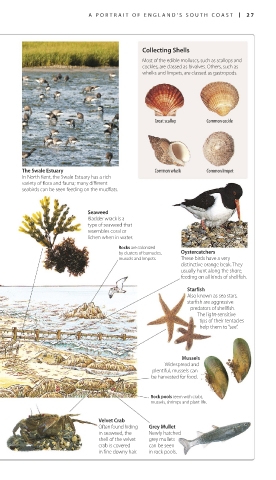
Collecting Shells
Most of the edible molluscs, such as scallops and
cockles, are classed as bivalves. Others, such as
whelks and limpets, are classed as gastropods.
Great scallop Common cockle
The Swale Estuary Common whelk Common limpet
In North Kent, the Swale Estuary has a rich
variety of flora and fauna; many different
seabirds can be seen feeding on the mudflats.
Seaweed
Bladder wrack is a
type of seaweed that
resembles coral or
lichen when in water.
Rocks are colonized
by clusters of barnacles, Oystercatchers
mussels and limpets. These birds have a very
distinctive orange beak. They
usually hunt along the shore,
feeding on all kinds of shellfish.
Starfish
Also known as sea stars,
starfish are aggressive
predators of shellfish.
The light-sensitive
tips of their tentacles
help them to “see”.
Mussels
Widespread and
plentiful, mussels can
be har vested for food.
Rock pools teem with crabs,
mussels, shrimps and plant life.
Velvet Crab
Often found hiding Grey Mullet
in seaweed, the Newly hatched
shell of the velvet grey mullets
crab is covered can be seen
in fine downy hair. in rock pools.
026-027_EW_ESC.indd 27 10/03/17 6:51 pm

