


Page 37 - World of Animals - Issue #31
P. 37
d o
                                                                                                            d o
                                                                                                                  f t
                                                                                                                     h
                                                                                                                  f t
                                                                                                           r
                                                                                                       L
                                                                                                       L
                                                                                                         o
                                                                                                           r
                                                                                                         o
                                                                                                                             e
                                                                                                                            i
                                                                                                                             e
                                                                                                                               s
 Damsels in distress                                                                              Damsels in distresss
                                                                                                                            i
                                                                                                                       e fl
                                                                                                                     h
                                                                                                                       e fl


                   Helicopter damselfly
                   These enormous spider-eating damselfl  ies
                   also prey on disease-spreading insects
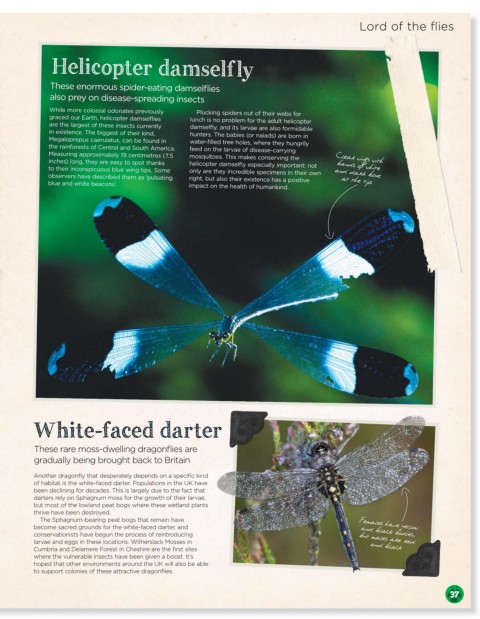
                   While more colossal odonates previously
                                                           Plucking spiders out of their webs for
                  graced our Earth, helicopter damselfl  ies
                                                         lunch is no problem for the adult helicopter
                  are the largest of these insects currently
                                                         damselfl  y, and its larvae are also formidable
                  in existence. The biggest of their kind,
                                                         hunters. The babies (or naiads) are born in
                  Megaloprepus caerulatus, can be found in
                                                         water-fi  lled tree holes, where they hungrily
                  the rainforests of Central and South America.
                                                         feed on the larvae of disease-carrying
                  Measuring approximately 19 centimetres (7.5
                                                         mosquitoes. This makes conserving the   Clear wings with
                  inches) long, they are easy to spot thanks
                                                         helicopter damselfl  y especially important: not   bands of white
                  to their inconspicuous blue wing tips. Some
                                                         only are they incredible specimens in their own   and dark blue
                  observers have described them as ‘pulsating
                                                         right, but also their existence has a positive   at the tips
                  blue and white beacons’.
                                                         impact on the health of humankind.


                                                       r
                                                          te
                                                               r
                                   a
                                      c
                        i
                          te
                               -
                                 f
                                         e
                    h
                                                    a
              White-faced darter
                                            d
                                                d
              W

              These rare moss-dwelling dragonflies are
              gradually being brought back to Britain

              Another dragonfly that desperately depends on a specific kind

              of habitat is the white-faced darter. Populations in the UK have
              been declining for decades. This is largely due to the fact that
              darters rely on Sphagnum moss for the growth of their larvae,
              but most of the lowland peat bogs where these wetland plants
              thrive have been destroyed.
                The Sphagnum-bearing peat bogs that remain have
              become sacred grounds for the white-faced darter, and                                    Females have yellow
              conservationists have begun the process of reintroducing                                 and black bodies,
              larvae and eggs in these locations. Witherslack Mosses in                                but males are red

              Cumbria and Delamere Forest in Cheshire are the first sites                                  and black
              where the vulnerable insects have been given a boost. It’s
              hoped that other environments around the UK will also be able
              to support colonies of these attractive dragonflies.

 36                                                                                                                            37 37
       032-038_DamselsinDistress.indd   37                                                                                   02/03/2016   14:24

