


Page 124 - (DK Eyewitness) Travel Guide - Sicily
P. 124
122 SICIL Y AREA B Y AREA
2 Siculiana
Road map C4. * 4,600. V from
Palermo and Trapani to Castelvetrano,
then @ n Town hall, Piazza Basile 23
(0922-818 011).
The present-day town of
Siculiana was built on the
site of an Arab fort destroyed
by the Normans in the late
11th century. The new lords –
the Chiaramonte family from
Agrigento – rebuilt the fortress
in the 1300s and it was altered
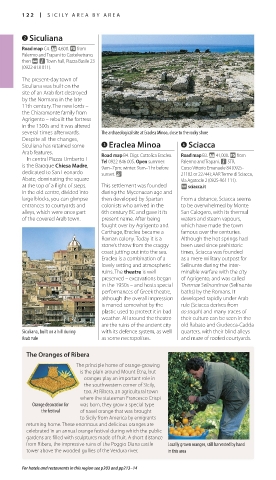
several times afterwards. The archaeological site at Eraclea Minoa, close to the rocky shore
Despite all the changes,
Siculiana has retained some 3 Eraclea Minoa 4 Sciacca
Arab features. Road map B4. Digs: Cattolica Eraclea. Road map B3. * 41,000. V from
In central Piazza Umberto I Tel 0922-846 005. Open summer: Palermo and Trapani. n STR,
is the Baroque Chiesa Madre, 9am–7pm; winter: 9am–1 hr before Corso Vittorio Emanuele 84 (0925-
dedicated to San Leonardo sunset. & 21182 or 22744); AAR Terme di Sciacca,
Abate, dominating the square Via Agatocle 2 (0925-961 111).
at the top of a flight of steps. This settlement was founded ∑ sciacca.it
In the old centre, divided into during the Mycenaean age and
large blocks, you can glimpse then developed by Spartan From a distance, Sciacca seems
entrances to courtyards and colonists who arrived in the to be overwhelmed by Monte
alleys, which were once part 6th century BC and gave it its San Calogero, with its thermal
of the covered Arab town. present name. After being waters and steam vapours,
fought over by Agrigento and which have made the town
Carthage, Eraclea became a famous over the centuries.
Roman colony. Today it is a Although the hot springs had
stone’s throw from the craggy been used since prehistoric
coast jutting out into the sea. times, Sciacca was founded
Eraclea is a combination of a as a mere military outpost for
lovely setting and atmospheric Selinunte during the inter-
ruins. The theatre is well minable warfare with the city
preserved – excavations began of Agrigento, and was called
in the 1950s – and hosts special Thermae Selinuntinae (Selinunte
performances of Greek theatre, baths) by the Romans. It
although the overall impression developed rapidly under Arab
is marred somewhat by the rule (Sciacca derives from
plastic used to protect it in bad as-saqah) and many traces of
weather. All around the theatre their culture can be seen in the
are the ruins of the ancient city old Rabato and Giudecca-Cadda
Siculiana, built on a hill during with its defence system, as well quarters, with their blind alleys
Arab rule as some necropolises. and maze of roofed courtyards.
The Oranges of Ribera
The principle home of orange-growing
is the plain around Mount Etna, but
oranges play an important role in
the southwestern corner of Sicily,
too. At Ribera, an agricultural town
where the statesman Francesco Crispi
Orange decoration for was born, they grow a special type
the festival of navel orange that was brought
to Sicily from America by emigrants
returning home. These enormous and delicious oranges are
celebrated in an annual orange festival during which the public
gardens are filled with sculptures made of fruit. A short distance
from Ribera, the impressive ruins of the Poggio Diana castle Locally grown oranges, still harvested by hand
tower above the wooded gullies of the Verdura river. in this area
For hotels and restaurants in this region see p203 and pp213–14
122-123_EW_Sicily.indd 122 11/3/16 2:09 PM
Eyewitness Travel LAYERS PRINTED:
Catalogue template “UK” LAYER
(Source v2.6)
Date 12th July 2013
Size 125mm x 217mm

