


Page 128 - (DK Eyewitness) Travel Guide - Sicily
P. 128
126 SICIL Y AREA B Y AREA
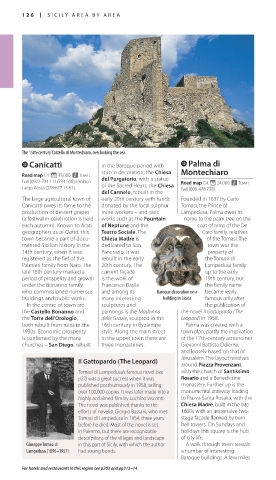
The 15th-century Castello di Montechiaro, overlooking the sea
w Canicattì in the Baroque period with e Palma di
stucco decoration; the Chiesa Montechiaro
Road map C4. * 35,000. n Town
hall (0922-734 111/734 508); Proloco del Purgatorio, with a statue Road map C4. * 24,000. n Town
Largo Aosta (328-677 13 61). of the Sacred Heart; the Chiesa hall (800-476 738).
del Carmelo, rebuilt in the
The large agricultural town of early 20th century with funds Founded in 1637 by Carlo
Canicattì owes its fame to the donated by the local sulphur Tomasi, the Prince of
production of dessert grapes mine workers – and civic Lampedusa, Palma owes its
(a festival in celebration is held works such as the Fountain name to the palm tree on the
each autumn). Known to Arab of Neptune and the coat of arms of the De
geographers as al-Qattà, this Teatro Sociale. The Caro family, relatives
town became a part of docu- Chiesa Madre is of the Tomasi. The
mented Sicilian history in the dedicated to San town was the
14th century, when it was Pancrazio. It was property of
registered as the fief of the rebuilt in the early the Tomasi di
Palmieri family from Naro. The 20th century. The Lampedusa family
late 18th century marked a current façade up to the early
period of prosperity and growth is the work of 19th century, but
under the Bonanno family, Francesco Basile the family name
who commissioned numerous and among its Baroque decoration on a became really
buildings and public works. many interesting building in Licata famous only after
In the centre of town are sculptures and the publication of
the Castello Bonanno and paintings is the Madonna the novel Il Gattopardo (The
the Torre dell’Orologio, delle Grazie, sculpted in the Leopard) in 1958.
both rebuilt from ruins in the 16th century in Byzantine Palma was created with a
1930s. Economic prosperity style. Along the main street town plan, partly the inspiration
is confirmed by the many in the upper town there are of the 17th-century astronomer
churches – San Diego, rebuilt three monasteries. Giovanni Battista Odierna,
and loosely based on that of
Il Gattopardo (The Leopard) Jerusalem. The layout revolves
around Piazza Provenzani,
Tomasi di Lampedusa’s famous novel (see with the church of Santissimo
p27) was a great success when it was Rosario and a Benedictine
published posthumously in 1958, selling monastery. Further up is the
over 100,000 copies. It was later made into a monumental stairway leading
highly acclaimed film by Luchino Visconti. to Piazza Santa Rosalia, with the
The novel was published thanks to the Chiesa Madre, built in the late
efforts of novelist Giorgio Bassani, who met 1600s with an impressive two-
Tomasi di Lampe dusa in 1954, three years stage façade flanked by twin
before he died. Most of the novel is set bell towers. On Sundays and
in Palermo, but there are recognizable holidays this square is the hub
descriptions of the villages and landscape of city life.
Giuseppe Tomasi di in this part of Sicily, with which the author A walk through town reveals
Lampedusa (1896–1957) had strong bonds. a number of inter esting
Baroque buildings. A few miles
For hotels and restaurants in this region see p203 and pp213–14
126-127_EW_Sicily.indd 126 11/3/16 2:10 PM
Eyewitness Travel LAYERS PRINTED:
Catalogue template “UK” LAYER
(Source v2.6)
Date 12th July 2013
Size 125mm x 217mm

