


Page 125 - (DK Eyewitness) Travel Guide - Sicily
P. 125
SOUTHWESTERN SICIL Y 123
5 Caltabellotta
Road map B3. * 4,000. n Town hall,
Piazza Umberto I 7 (0925-951 013).
Visible from most of the hilly
area of Sciacca, the rocky crest
of Caltabellotta (950 m/3,116 ft)
has been inhabited for millen-
nia, as can be seen in the many
ancient necro polises and
hypogea. The site was fortified
at different stages until the
arrival of the Arabs, who gave
the castle its definitive form,
calling it Kal’at–at–al ballut
(rock of the oak trees). The
county capital, Caltabellotta
witnessed the signing of peace
The rusticated façade of the Catalan-Gothic Palazzo Steripinto, Sciacca between Charles I of Valois and
Frederick II of Aragón in 1302
The town was further fortified Lilibeo, with the limestone ridge (see pp32–3), who took over the
by the Normans, who quickly of Caltabellotta in the back- whole of Sicily. Perched on the
recognized its strategic ground and Pantelleria ridge above the houses
importance in controlling the island before you. The of the Torrevecchia
trade routes. Much fought over older spas are on the quarter are the ruins
in the years that followed, the slopes of the of the Norman
town was fortified again and mountain, while castle and San
again, in particular against the new ones have Salvatore, while
assault of Charles I of Valois. been built closer on the other
In the middle of town is to the seaside. side of the rock is
Palazzo Steripinto, built in Sciacca is also the Chiesa Madre,
Catalan-Gothic style in 1501 known for its ceramics, now being restored,
with a rusticated façade. The mentioned in antiquity founded by Roger I
church of Santa Margherita has by Diodorus Siculus. Local to celebrate his victory
a splendid Gothic portal; note the production thrived during over the Arabs. On the
bas-relief sculpture in the lunette the period of Arab western slope, the
representing Santa Margherita, rule, and another Sculpture at the Hermitage Hermitage of San
the Arch angel Gabriel, Our Lady golden age came in of San Pellegrino Pellegrino, which
of the Assumption and saints the 16th century. The consists of a
Calogero and Maddalena. Do not tradition is being maintained monastery and a chapel,
miss the cloister of the former today by local craftsmen. dominates the town.
Convent of San Francesco and
the unfinished Baroque façade
of the Chiesa del Carmine, with
its 14th-century rose window.
In central Piazza Don Minzoni
stands the Cathedral, dedica ted
to Santa Maria Maddalena. It was
rebuilt in 1656, but retains three
Norman apses.
However, the main attrac-
tions in Sciacca are Monte San
Calogero and its thermal pools.
From the large square at the
summit, with the sanctuary
dedicated to the evangelist
San Calogero, who in the
5th century eliminated pagan
rites in the mountain caves,
the panorama is breathtaking.
The summit is almost 400 m
(1,312 ft) high, and on a clear
day there is a commanding
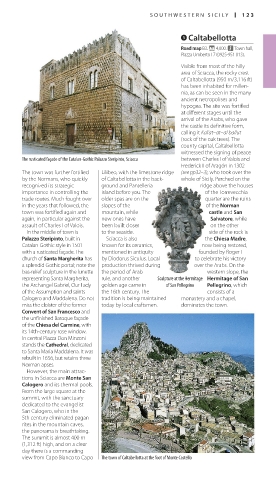
view from Capo Bianco to Capo The town of Caltabellotta at the foot of Monte Castello
122-123_EW_Sicily.indd 123 11/3/16 2:09 PM

