


Page 27 - (DK Eyewitness) Travel Guide - Sicily
P. 27
a por tr ait of sicil y 25
Medieval Churches
Interlacing Rich decoration
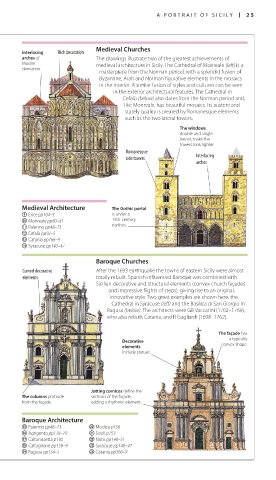
arches of The drawings illustrate two of the greatest achievements of
Muslim medieval architecture in Sicily. The Cathedral of Monreale (left) is a
derivation.
masterpiece from the Norman period, with a splendid fusion of
Byzantine, Arab and Norman figurative elements in the mosaics
in the interior. A similar fusion of styles and cultures can be seen
in the exterior architectural features. The Cathedral in
Cefalù (below) also dates from the Norman period and,
like Monreale, has beautiful mosaics. Its austere and
stately quality is created by Romanesque elements
such as the two lateral towers.
The windows,
double and single
lancet, make the
towers look lighter.
Romanesque
side towers Interlacing
arches
Medieval Architecture The Gothic portal
9 Erice pp104–5 is under a
0 Monreale pp80–81 15th-century
narthex.
q Palermo pp48–73
w Cefalù pp92–5
e Catania pp166–9
r Syracuse pp140–47
Baroque Churches
Curved decorative After the 1693 earthquake the towns of eastern Sicily were almost
elements totally rebuilt. Spanish-influenced Baroque was combined with
Sicilian decorative and structural elements (convex church façades
and impressive flights of steps), giving rise to an original,
innovative style. Two great examples are shown here: the
Cathedral in Syracuse (left) and the Basilica di San Giorgio in
Ragusa (below). The architects were GB Vaccarini (1702–1769),
who also rebuilt Catania, and R Gagliardi (1698–1762).
The façade has
a typically
Decorative
elements convex shape.
include statues.
Jutting cornices define the
The columns protrude sections of the façade,
from the façade. adding a rhythmic element.
Baroque Architecture
t Palermo pp48–73 p Modica p156
y Agrigento pp118–19 a Scicli p153
u Caltanissetta p130 s Noto pp148–51
i Caltagirone pp158–9 d Syracuse pp140–47
o Ragusa pp154–5 f Catania pp166–9
SC_024-025_Feat4.indd 25 17/11/2014 15:50

