


Page 28 - (DK Eyewitness) Travel Guide - Sicily
P. 28
26 INTRODUCING SICIL Y
Sicilian Literature and Art The 18th century was another
fallow period for literary
In the history of Sicilian art and literature there have production, and it was not
been periods of tremendous creativity and others when until the mid-1800s that
little of note was produced. In the field of literature, the there was a rebirth of Sicilian
literature. The writers
13th-century Sicilian School of lyric poetry, 19th-century Giovanni Verga and Federico
verismo, or realism, and Luigi Pirandello’s novels and De Roberto became the
plays scale the heights of Italian and European literary mainspring of the realistic
production. In the field of art, Sicily has produced such novel, verismo.
illustrious artists as Antonello da Messina, one of the great This style of
figures in 15th-century rationalism and por traiture, and writing was an
extreme and, to a
the modern painter Renato Guttuso. certain extent,
more refined
version of French
The first known figure in naturalism, as
medieval Sicilian literature is embodied in the
the Arab poet ’Ibn Hamdis, work of Emile
who was born in Syracuse in Zola. Giovanni Guidebook by Federico
1055 and was forced to leave Verga was born De Roberto
the island while still young. He in Catania in
wrote moving verses filled 1840. After producing work
with nostalgia for the land of in a late Romantic vein, in the
his youth. 1870s he was drawn to French
In the 13th century, the first naturalism by creating his
school of lyric poetry in Italy so-called “poetic of the
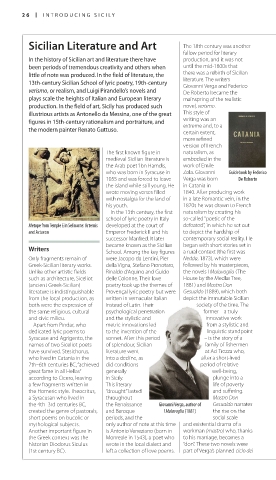
Metope from Temple E in Selinunte: Artemis developed at the court of defeated”, in which he set out
and Actaeon Emperor Frederick II and his to depict the hardship of
successor Manfred. It later contemporary social reality. He
became known as the Sicilian began with short stories set in
Writers School. Among the key figures a rural context (the first was
Only fragments remain of were Jacopo da Lentini, Pier Nedda, 1873), which were
Greek-Sicilian literary works. della Vigna, Stefano Pronotaro, followed by his masterpieces,
Unlike other artistic fields Rinaldo d’Aquino and Guido the novels I Malavoglia (The
such as architecture, Siceliot delle Colonne. Their love House by the Medlar Tree,
(ancient Greek-Sicilian) poetry took up the themes of 1881) and Mastro Don
literature is indistinguishable Provençal lyric poetry but were Gesualdo (1889), which both
from the local production, as written in vernacular Italian depict the immutable Sicilian
both were the expression of instead of Latin. Their society of the time. The
the same religious, cultural psychological penetration former – a truly
and civic milieu. and the stylistic and innovative work
Apart from Pindar, who metric innovations led from a stylistic and
dedicated lyric poems to to the invention of the linguistic standpoint
Syracuse and Agrigento, the sonnet. After this period – is the story of a
names of two Siceliot poets of splendour, Sicilian family of fishermen
have survived. Stesichorus, literature went at Aci Trezza who,
who lived in Catania in the into a decline, as after a short-lived
7th–6th centuries BC, “achieved did conditions period of relative
great fame in all Hellas” generally well-being,
according to Cicero, leaving in Sicily. plunge into a
a few fragments written in This literary life of poverty
the Homeric style. Theocritus, “drought” lasted and suffering.
a Syracusan who lived in throughout Mastro Don
the 4th–3rd centuries BC, the Renaissance Giovanni Verga, author of Gesualdo narrates
created the genre of pastorals, and Baroque I Malavoglia (1881) the rise on the
short poems on bucolic or periods, and the social scale
mythological subjects. only author of note at this time and existential drama of a
Another important figure in is Antonio Veneziano (born in workman (mastro) who, thanks
the Greek context was the Monreale in 1543), a poet who to his marriage, becomes a
historian Diodorus Siculus wrote in the local dialect and “don”. These two novels were
(1st century BC). left a collection of love poems. part of Verga’s planned ciclo dei
026-027_EW_Sicily.indd 26 11/3/16 2:09 PM
Eyewitness Travel LAYERS PRINTED:
Feature template “UK” LAYER
(SourceReport v1.6)
Date 27th March 2014
Size 125mm x 217mm

