


Page 128 - (DK Eyewitness) Travel Guide - Europe
P. 128
126 BRIT AIN AND IRELAND
Early-Celtic Christianity Conical roof
Lookout window
Ireland became Christian in the 5th century, following
the missions of St. Patrick and others. The situation was
soon reversed, with many Irish missionaries, such as St. Wooden floor
Columba and St. Columbanus, sailing to Great Britain, Movable ladder
France, and beyond. The Irish church developed more
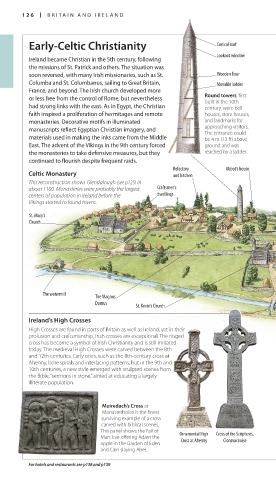
or less free from the control of Rome, but nevertheless Round towers, first
built in the 10th
had strong links with the east. As in Egypt, the Christian century, were bell
faith inspired a proliferation of hermitages and remote houses, store houses,
monasteries. Decorative motifs in illuminated and landmarks for
manuscripts reflect Egyptian Christian imagery, and approaching visitors.
The entrance could
materials used in making the inks came from the Middle be 4 m (13 ft) above
East. The advent of the Vikings in the 9th century forced ground and was
the monasteries to take defensive measures, but they reached by a ladder.
continued to flourish despite frequent raids.
Refectory Abbot’s house
Celtic Monastery and kitchen
This reconstruction shows Glendalough (see p125) in
about 1100. Monasteries were probably the largest Craftsmen’s
centers of population in Ireland before the dwellings
Vikings started to found towns.
St. Mary’s
Church
The watermill The Magnus
Domus St. Kevin’s Church
Ireland’s High Crosses
High Crosses are found in parts of Britain as well as Ireland, yet in their
profusion and craftsmanship, Irish crosses are exceptional. The ringed
cross has become a symbol of Irish Christianity and is still imitated
today. The medieval High Crosses were carved between the 8th
and 12th centuries. Early ones, such as the 8th-century cross at
Ahenny, bore spirals and interlacing patterns, but in the 9th and
10th centuries, a new style emerged with sculpted scenes from
the Bible, “sermons in stone,” aimed at educating a largely
illiterate population.
Muiredach’s Cross at
Monasterboice is the finest
surviving example of a cross
carved with biblical scenes.
This panel shows the Fall of Ornamental High Cross of the Scriptures,
Man: Eve offering Adam the
apple in the Garden of Eden Cross at Ahenny Clonmacnoise
and Cain slaying Abel.
For hotels and restaurants see p138 and p139
126-127_EW_Europe.indd 126 14/07/16 10:13 am

