


Page 252 - (DK Eyewitness) Travel Guide - Europe
P. 252
250 FR ANCE AND THE L OW C OUNTRIES
Exploring the Rijksmuseum 1800–1900
The Rijksmuseum is too vast to be seen in a single visit. If time The 19th-century collection
is limited, start with the incomparable 17th-century Dutch features works by the Hague
paintings, taking in Rembrandt, Frans Hals, Vermeer, and many School, a group of Dutch
other Old Masters. The collection of Asiatic artifacts is equally artists who came together in
around 1870 in Den Haag.
wonderful, and a tour of the special-collections section also Their landscape work captures
provides a rewarding experience. The gardens, redesigned the atmospheric quality of
according to Cuypers’ original plans, are also well worth a look. subdued Dutch sunlight.
Look out for Anton Mauve’s
and The Woman Reading Morning Ride on the Beach
a Letter (1662). Of several (1876) and the beautiful
portraits by Frans Hals Polder landscape, View near
(1580–1666), the best- the Geestbrug, by Hendrik
known are The Wedding Weissenbruch (1824–1903).
Portrait and The Merry
Drinker (1630). The 1900–2000
Windmill at Wijk by
Jacob van Ruisdael Below the rafters is a series of
(1628–82) is a great rooms devoted to 20th-century
landscape by an artist art and design. Highlights in
at the height of his this section include a white
career. Other artists version of Gerrit Rietveld’s
whose works contribute iconic red-and-blue armchair
to this unforgettable (1923), Karel Appel’s imposing
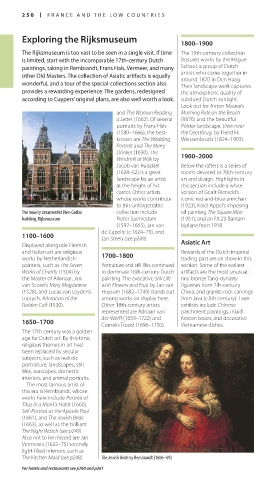
The heavily ornamented Neo-Gothic collection include oil painting The Square Man
building, Rijksmuseum Pieter Saenredam (1951), and an F.K.23 Bantam
(1597–1665), Jan van biplane from 1918.
de Capelle (c.1624–79), and
1100–1600 Jan Steen (see p249).
Displayed alongside Flemish Asiatic Art
and Italian art are religious Rewards of the Dutch imperial
works by Netherlandish 1700–1800 trading past are on show in this
painters, such as The Seven Portraiture and still lifes continued section. Some of the earliest
Works of Charity (1504) by to dominate 18th-century Dutch artifacts are the most unusual:
the Master of Alkmaar, Jan painting. The evocative Still Life tiny bronze Tang-dynasty
van Scorel’s Mary Magdalene with Flowers and Fruit by Jan van figurines from 7th-century
(1528), and Lucas van Leyden’s Huysum (1682–1749) stands out China, and granite rock carvings
triptych, Adoration of the among works on display here. from Java (c.8th century). Later
Golden Calf (1530). Other 18th-century artists exhibits include Chinese
represented are Adriaan van parchment paintings, inlaid
der Werff (1659–1722) and Korean boxes, and decorative
1650–1700
Cornelis Troost (1696–1750). Vietnamese dishes.
The 17th century was a golden
age for Dutch art. By this time,
religious themes in art had
been replaced by secular
subjects, such as realistic
portraiture, landscapes, still
lifes, seascapes, domestic
interiors, and animal portraits.
The most famous artist of
this era is Rembrandt, whose
works here include Portrait of
Titus in a Monk’s Habit (1660),
Self-Portrait as the Apostle Paul
(1661), and The Jewish Bride
(1663), as well as the brilliant
The Night Watch (see p249).
Also not to be missed are Jan
Vermeer’s (1632–75) serenely
light-filled interiors, such as
The Kitchen Maid (see p248) The Jewish Bride by Rembrandt (1606–69)
For hotels and restaurants see p260 and p261
250-251_EW_Europe.indd 250 14/07/16 10:14 am

