


Page 350 - (DK Eyewitness) Travel Guide - Europe
P. 350
348 THE IBERIAN PENINSULA
r Mosteiro dos Jerónimos
A monument to the wealth of Portugal’s Age of
Discovery, the monastery is the culmination of the
Manueline style of architecture. Commissioned by
Manuel I in around 1501, soon after Vasco da Gama’s
return from his historic voyage, it was funded largely
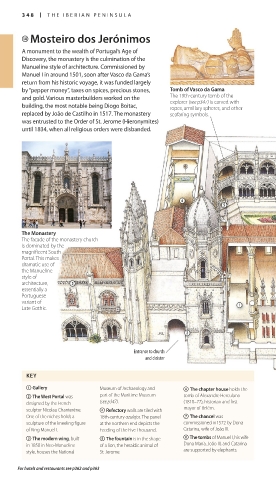
by “pepper money”, taxes on spices, precious stones, Tomb of Vasco da Gama
and gold. Various masterbuilders worked on the The 19th-century tomb of the
explorer (see p347) is carved with
building, the most notable being Diogo Boitac, ropes, armillary spheres, and other
replaced by João de Castilho in 1517. The monastery seafaring symbols.
was entrusted to the Order of St. Jerome (Hieronymites)
until 1834, when all religious orders were disbanded.
The Monastery
The facade of the monastery church
is dominated by the
magnificent South
Portal. This makes
dramatic use of
the Manueline
style of
architecture,
essentially a
Portuguese
variant of
Late Gothic.
Entrance to church
and cloister
KEY
1 Gallery Museum of Archaeology and 6 The chapter house holds the
2 The West Portal was part of the Maritime Museum tomb of Alexandre Herculano
designed by the French (see p347). (1810–77), historian and first
sculptor Nicolau Chanterène. 4 Refectory walls are tiled with mayor of Belém.
One of the niches holds a 18th-century azulejos. The panel 7 The chancel was
sculpture of the kneeling figure at the northern end depicts the commissioned in1572 by Dona
of King Manuel I. Feeding of the Five Thousand. Catarina, wife of João III.
3 The modern wing, built 5 The fountain is in the shape 8 The tombs of Manuel I, his wife
in 1850 in Neo-Manueline of a lion, the heraldic animal of Dona Maria, João III, and Catarina
style, houses the National St. Jerome. are supported by elephants.
For hotels and restaurants see p362 and p363
348-349_EW_Europe.indd 348 14/07/16 10:16 am

