


Page 352 - (DK Eyewitness) Travel Guide - Europe
P. 352
350 THE IBERIAN PENINSULA
3 Sintra + Castelo dos Mouros
Estrada da Pena, 5 km (3 miles) S. Tel
* 25,000. £ @ n Praça da 219-237 300. @ 434 or taxi from Sintra.
Républica 23 (219-231 157). ( 2nd Open daily. Closed Jan 1, Dec 25.
and 4th Sun of month in São Pedro.
_ Sintra Festival (Jun–Jul). P Palácio da Pena
Estrada da Pena, 5 km (3 miles) S.
Sintra’s setting among wooded Tel 219-237 300. @ 434 or taxi
ravines and fresh-water springs from Sintra. Open daily.
made it a favorite summer Closed Jan 1, Dec 25. &
retreat for the kings of Portugal, ∑ parquesdesintra.pt
who built the fabulous
Beach at Estoril, east of Cascais Palácio Nacional de Sintra 4 Tomar
(see pp352–3) here.
2 Cascais Designated a UNESCO World * 43,000. £ @ n Avda Dr.
Heritage site in 1995, the town Cândido Madureira (249-329 823).
* 33,000. £ @ n Largo da
Cidade de Vitória (214-668 167). draws thousands of visitors, yet ( Fri. _ Festa dos Tabuleiros (Jul,
( first and third Sundays in month. there are many tranquil walks every 4 years, next one will be 2019).
in the surrounding hills.
A harbor since prehistoric times, Present-day Sintra is a maze Founded in 1157 by Gualdim
Cascais became a fashionable of winding roads, and exploring Pais, the first Grand Master
resort in the 1870s, when the town on foot involves much of the Order of the Templars in
Luís I’s summer palace was walking and climbing; for a Portugal, Tomar is dominated
sited here. Today, it is a bustling more leisurely tour, by the castle containing
cosmopolitan resort, with take a horse-and the Convento
many upscale stores in the carriage ride. The de Cristo. It was
pedestrian streets of the old Miradouro da Vigia begun in 1162, built
town and a new marina in São Pedro offers on land given to the
complex. Fishing is still an impressive views, as Templars for services
important activity, and the does the cozy Casa in battle, and
day’s catch is auctioned near de Sapa café, where preserves many
the harbor in the afternoon. you can sample traces of its founders
queijadas, cheese and the inheritors of
Environs tarts spiced their mantle, the
Along the coast, 3 km (2 miles) with cinnamon. Order of Christ. The
to the east, the resort of Estoril High above the nucleus of the castle
has been home to exiled town is the Castelo is the 12th-century
European royalty. It has retained dos Mouros, an Charola, the Templars’
its sense of place with grand 8th-century Moorish Manueline window at octagonal oratory. In
villas and hotels lining the coast. castle. On a nearby Tomar’s monastery 1356, Tomar became
Guincho, 10 km (6 miles) west hilltop stands the the headquarters of
of Cascais, has a magnificent Palácio da Pena, built in the the Order of Christ.
sandy beach. Its Atlantic 19th century for Ferdinand, King Cloisters were built in the
breakers make it popular with Consort of Maria II, in a bizarre time of Henry the Navigator,
surfers. Further north is Cabo medley of architectural styles. but it was in the reigns of
da Roca, the most westerly A magnificent park surrounds Manuel I (1495–1521) and his
point of mainland Europe. the fairy-tale castle. successor, João III (1521–57),
that the greatest changes were
made, with the addition of the
Manueline church and
Renaissance cloisters. The
church window (c.1510),
commissioned by Manuel I,
is probably the best-known
single example of the
Manueline style of architecture.
Other fascinating features
include the Terrace of Wax,
where honeycombs were left
to dry, and the “bread” cloister,
where loaves were handed
out to the poor.
The town of Tomar is the
site of the curious Festa dos
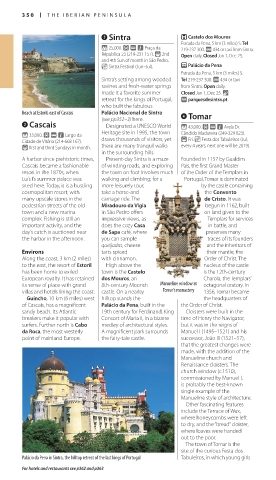
Palácio da Pena in Sintra, the hilltop retreat of the last kings of Portugal Tabuleiros, in which young girls
For hotels and restaurants see p362 and p363
350-351_EW_Europe.indd 350 14/07/16 10:16 am

