


Page 427 - (DK Eyewitness) Travel Guide - Europe
P. 427
IT AL Y 425
d Ravenna f Urbino
* 140,000. £ @ n Via Salara * 16,000. @ n Piazza
8–12 (0544-357 55). ( Wed & Sat. Rinascimento 1 (0722-26 13). ( Sat.
∑ turismo.ravenna.it
Urbino traces its origins to
Ravenna rose to power in the the Umbrians, centuries before
1st century BC when Emperor Christ, and became a Roman
Augustus built a port and naval municipality in the 3rd century
base nearby, but gained further BC. The city’s zenith, however,
prominence after becoming the came in the 15th century under
administrative capital of the the rule of the philosopher-
Byzantine Empire in AD 402. warrior Federico da Montefeltro,
Most people visit the city for its who commissioned the building
superb early Christian mosaics. of the Palazzo Ducale in 1444.
Spanning the years of Roman This beautiful Renaissance
and Byzantine rule, they can be palace has an extensive library,
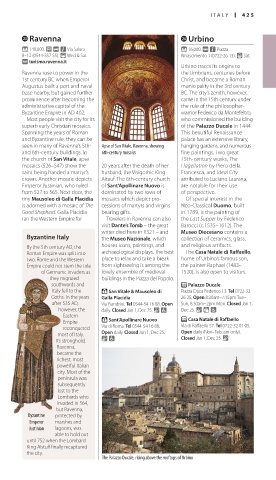
seen in many of Ravenna’s 5th- Apse of San Vitale, Ravenna, showing hanging gardens, and numerous
and 6th-century buildings. In 6th-century mosaics fine paintings. Two great
the church of San Vitale, apse 15th-century works, The
mosaics (526–547) show the 20 years after the death of her Flagellation by Piero della
saint being handed a martyr’s husband, the Visigothic King Francesca, and Ideal City
crown. Another mosaic depicts Altauf. The 6th-century church attributed to Luciano Laurana,
Emperor Justinian, who ruled of Sant’Apollinare Nuovo is are notable for their use
from 527 to 565. Next door, the dominated by two rows of of perspective.
tiny Mausoleo di Galla Placidia mosaics which depict pro- Of special interest in the
is adorned with a mosaic of The cessions of martyrs and virgins Neo-Classical Duomo, built
Good Shepherd. Galla Placidia bearing gifts. in 1789, is the painting of
ran the Western Empire for Travelers in Ravenna can also the Last Supper by Federico
visit Dante’s Tomb – the great Barocci (c.1535–1612). The
writer died here in 1321 – and Museo Diocesano contains a
Byzantine Italy the Museo Nazionale, which collection of ceramics, glass,
By the 5th century AD, the houses icons, paintings, and and religious artifacts.
Roman Empire was split into archaeological displays. The best The Casa Natale di Raffaello,
two. Rome and the Western place to relax and take a break home of Urbino’s famous son,
Empire could not stem the tide from sightseeing is among the the painter Raphael (1483–
of Germanic invaders as lovely ensemble of medieval 1520), is also open to visitors.
they migrated buildings in the Piazza del Popolo.
southwards and P Palazzo Ducale
Italy fell to the R San Vitale & Mausoleo di Piazza Duca Federico 13. Tel 0722-32
Goths. In the years Galla Placidia 26 25. Open 8:30am–7:15pm Tue–
after 535 AD, Via Fiandrini. Tel 0544-54 16 88. Open Sun, 8:30am–2pm Mon. Closed Jan 1,
however, the daily. Closed Jan 1, Dec 25. & 7 Dec 25. & = 7
Eastern R Sant’Apollinare Nuovo P Casa Natale di Raffaello
Empire Via di Raffaello 57. Tel 0722-32 01 05.
reconquered Via di Roma. Tel 0544-54 16 88.
most of Italy. Open daily. Closed Jan 1, Dec 25. Open daily (Nov–Feb: am only).
Its stronghold, & 7 Closed Jan 1, Dec 25. &
Ravenna,
became the
richest, most
powerful Italian
city. Most of the
peninsula was
subsequently
lost to the
Lombards who
invaded in 564,
but Ravenna,
Byzantine protected by
Emperor marshes and
Justinian lagoons, was
able to hold out
until 752 when the Lombard
King Aistulf finally recaptured
the city.
The Palazzo Ducale, rising above the rooftops of Urbino
424-425_EW_Europe.indd 425 14/07/16 10:17 am

