


Page 430 - (DK Eyewitness) Travel Guide - Europe
P. 430
428 IT AL Y AND GREECE
Sicily E Galleria Regionale di Sicilia
Via Alloro 4. Tel 091-623 00 11.
Located at a crossroads in the Mediterranean, Sicily was a Open am daily, pm Tue–Thu. &
magnet for colonists and invaders from half the ancient P Palazzo Reale &
civilized world. As Greek, Arab, and Norman conquerors came Cappella Palatina
and went, they left behind a rich and varied cultural heritage. Piazza Indipendenza. Tel 091-626 28
33. Open daily. &
This has evolved into a colorful mixture of language, customs,
and cuisine, and is reflected in the diverse art and architecture E Museo Regionale Salinas
of the island. Sicily has magnificent beaches, remote hilltowns, Piazza Olivella 24. Tel 091-611 68 06.
flower-covered mountain ranges, and an active volcano Open Tue–Sun (am only Sat, Sun &
whose lava flows over the centuries have created a fertile hols). &
land of walnut trees, citrus groves, and vineyards.
Environs
A few miles inland from
Palermo, the cathedral at
Monreale, founded in 1172,
is one of the great sights of
Norman Sicily. The glittering
mosaics and Saracenic-style
cloisters, represent Norman
artistry at its peak.
R Monreale
Piazza Vittorio Emanuele. @ 8
Cloister: Tel 091-640 44 13. Open daily
(am only Sun & hols). & for treasury
& terrace.
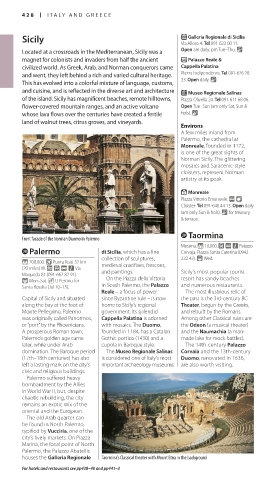
l Taormina
Front facade of the Norman Duomo in Palermo
Messina. * 10,000. £ @ n Palazzo
k Palermo di Sicilia, which has a fine Corvaja, Piazza Santa Caterina (0942
collection of sculptures, 232 43). ( Wed.
* 700,000. k Punta Raisi 32 km
(20 miles) W. g £ @ n Via medieval crucifixes, frescoes,
Maqueda 81 (091-662 82 91). and paintings. Sicily’s most popular tourist
( Mon–Sat. _ U Festinu for On the Piazza della Vittoria resort has sandy beaches
Santa Rosalia (Jul 10–15). in South Palermo, the Palazzo and numerous restaurants.
Reale – a focus of power The most illustrious relic of
Capital of Sicily and situated since Byzantine rule – is now the past is the 3rd-century BC
along the bay at the foot of home to Sicily’s regional Theater, begun by the Greeks,
Monte Pellegrino, Palermo government. Its splendid and rebuilt by the Romans.
was originally called Panormos, Cappella Palatina is adorned Among other Classical ruins are
or “port” by the Phoenicians. with mosaics. The Duomo, the Odeon (a musical theater)
A prosperous Roman town, founded in 1184, has a Catalan and the Naumachia (a man-
Palermo’s golden age came Gothic portico (1430) and a made lake for mock battles).
later, while under Arab cupola in Baroque style. The 14th-century Palazzo
domination. The Baroque period The Museo Regionale Salinas Corvaia and the 13th-century
(17th–18th centuries) has also is considered one of Italy’s most Duomo, renovated in 1636,
left a lasting mark on the city’s important archaeology museums. are also worth visiting.
civic and religious buildings.
Palermo suffered heavy
bombardment by the Allies
in World War II, but, despite
chaotic rebuilding, the city
remains an exotic mix of the
oriental and the European.
The old Arab quarter can
be found in North Palermo,
typified by Vucciria, one of the
city’s lively markets. On Piazza
Marina, the focal point of North
Palermo, the Palazzo Abatellis
houses the Galleria Regionale Taormina’s Classical theater with Mount Etna in the background
For hotels and restaurants see pp438–40 and pp441–3
428-429_EW_Europe.indd 428 14/07/16 10:17 am

