


Page 429 - (DK Eyewitness) Travel Guide - Europe
P. 429
IT AL Y 427
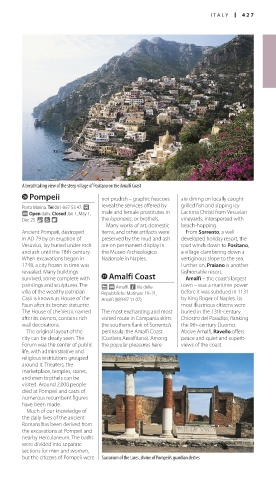
A breathtaking view of the steep village of Positano on the Amalfi Coast
h Pompeii not prudish – graphic frescoes are dining on locally caught
Porta Marina. Tel 081-857 53 47. £ reveal the services offered by grilled fish and sipping icy
@ Open daily. Closed Jan 1, May 1, male and female prostitutes in Lacrima Christi from Vesuvian
Dec 25. & 7 8 the lupanares, or brothels. vineyards, interspersed with
Many works of art, domestic beach-hopping.
Ancient Pompeii, destroyed items, and other artifacts were From Sorrento, a well-
in AD 79 by an eruption of preserved by the mud and ash developed holiday resort, the
Vesuvius, lay buried under rock are on permanent display in road winds down to Positano,
and ash until the 18th century. the Museo Archeologico a village clambering down a
When excavations began in Nazionale in Naples. vertiginous slope to the sea.
1748, a city frozen in time was Further on, Praiano is another
revealed. Many buildings j Amalfi Coast fashionable resort.
survived, some complete with Amalfi – the coast’s largest
paintings and sculptures. The g @ Amalfi. n Via delle town – was a maritime power
villa of the wealthy patrician Repubbliche Marinare 19–21, before it was subdued in 1131
Casii is known as House of the Amalfi (089-87 11 07). by King Roger of Naples. Its
Faun after its bronze statuette. most illustrious citizens were
The House of the Vettii, named The most enchanting and most buried in the 13th-century
after its owners, contains rich visited route in Campania skirts Chiostro del Paradiso, flanking
wall decorations. the southern flank of Sorrento’s the 9th-century Duomo.
The original layout of the peninsula: the Amalfi Coast Above Amalfi, Ravello offers
city can be clearly seen. The (Costiera Amalfitana). Among peace and quiet and superb
Forum was the center of public the popular pleasures here views of the coast.
life, with administrative and
religious institutions grouped
around it. Theaters, the
marketplace, temples, stores,
and even brothels can be
visited. Around 2,000 people
died at Pompeii and casts of
numerous recumbent figures
have been made.
Much of our knowledge of
the daily lives of the ancient
Romans has been derived from
the excavations at Pompeii and
nearby Herculaneum. The baths
were divided into separate
sections for men and women,
but the citizens of Pompeii were Sacrarium of the Lares, shrine of Pompeii’s guardian deities
426-427_EW_Europe.indd 427 14/07/16 10:45 am

