


Page 715 - (DK Eyewitness) Travel Guide - Europe
P. 715
W ARSA W 713
5 Royal Route 19th-century town houses.
It is also one of the busiest
Krakowskie Przedmieście and Nowy shopping streets in the world,
Świat. @ 116, 175, 180, 503.
and full of large stores,
The Royal Route (Trakt fashionable boutiques, colorful
Królewski) is one of Warsaw’s sidewalk cafés, and a wide
most historic and beautiful choice of restaurants.
streets. Starting by Castle
Square (Plac Zamkowy), and
continuing all the way to the
royal palace at Wilanów, the
most interesting part of the
route is along Krakowskie
Przedmieście and Nowy Świat.
These thoroughfares developed
in the late Middle Ages, with
The magnificent Rococo organ loft of their rural setting, by the banks
St. Anna’s Church of the Vistula river, attracting
Warsaw’s aristocracy and
4 St. Anna’s Church wealthy merchant class.
Krakowskie Przedmieście 68. @ 116, This social elite built grand
175, 178, 180, 195, 503. Open daily. summer residences and town
houses here, while religious
This imposing church on the orders established lavish Imposing Neoclassical facade of the
Royal Route was founded by churches and monasteries. Grand Theater
Anna, the widow of Duke Krakowskie Przedmieście 6 Grand Theater
Bolesław III, and built in the features many buildings from
late 15th century, along with the 17th and 18th centuries, Plac Teatralny. Tel 22-826 50 19. @
a Bernardine monastery. with several imposing palaces 111, 128, 175. Ticket office: Open daily.
Extended between 1518 and standing back from the road
1533, the church was destroyed behind tree-lined squares and One of the city’s largest
during the Swedish invasion of courtyards. Alongside, there buildings before World War II,
1655, but later rebuilt in are impressive town houses the Grand Theater was built in
Baroque style. The Neoclassical and some of the city’s most 1825–33, to a design by
facade was a subsequent interesting churches, including Antonio Corazzi and Ludwik
addition, as was the free- St. Anna’s, St. Joseph’s, and Kozubowski. Many renowned
standing bell tower, which the Church of the Assumption. craftsmen also contributed to
dates from the 1820s. Warsaw University and the Fine the sublime, palatial interiors.
The church has a magnificent Arts Academy are also located Initially, the building was to be
interior, with several Rococo here, while various monuments named the National Theater,
altars, a splendid organ, and pay tribute to but the defeat of the 1830
frescoes by Walenty Żebrowski. eminent Poles. November Uprising forced a
A side chapel contains the relics Nowy Świat is change of name. The two
of St. Władysław of Gielniów, lined with long statues that stand in front
Warsaw’s patron saint. St. Anna’s rows of 18th- and of the building are of the
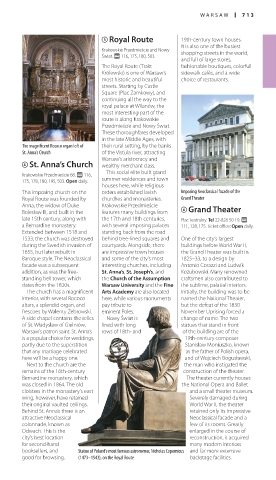
is a popular choice for weddings, 19th-century composer
partly due to the superstition Stanisław Moniuszko, known
that any marriage celebrated as the father of Polish opera,
here will be a happy one. and of Wojciech Bogusławski,
Next to the church are the the man who instigated the
remains of the 16th-century construction of the theater.
Bernardine monastery, which The theater currently houses
was closed in 1864. The old the National Opera and Ballet
cloisters in the monastery’s east and a small theater museum.
wing, however, have retained Severely damaged during
their original vaulted ceilings. World War II, the theater
Behind St. Anna’s there is an retained only its impressive
attractive Neoclassical Neoclassical facade and a
colonnade, known as few of its rooms. Greatly
Odwach. This is the enlarged in the course of
city’s best location reconstruction, it acquired
for second-hand many modern interiors
booksellers, and Statue of Poland’s most famous astronomer, Nicholas Copernicus and far more extensive
good for browsing. (1473–1543), on the Royal Route backstage facilities.
712-713_EW_Europe.indd 713 14/07/16 10:20 am

