


Page 84 - How It Works - Book of Amazing Answers To Curious Questions, 12
P. 84
�  AMAZIG ANSWERS TO CURIOUS QUESTIONS ------------------


         How did Romans ID<e to relax?


         Learn about bathing, Roman style

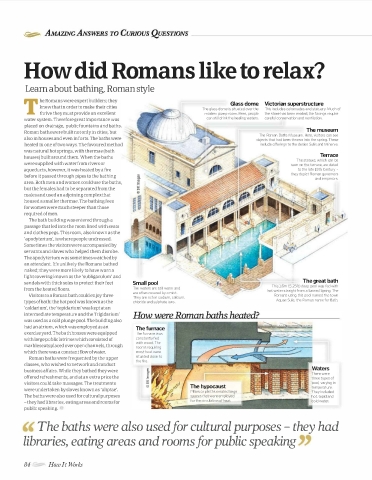
              he Romans were expert builders; they                         Glass dome  Victorian superstructure
              knew that in order to make their cities             The glass dome is situated over the   This  includes colonnades and statuary. Much of
         T  thrive they must provide an excellent                  modern pump room. Here, people   the stone has been  eroded; the facings require
         water system. Therefore great importance was              can still drink the healing waters.   careful conservation and ventilation.
         placed on drainage, public fountains and baths.
         Roman baths were built not only in cities, but                                            The museum
                                                                                    The  Roman  Baths Museum. Here, visitors can see
         also in houses and even in forts. The baths were                          objects that had  been thrown into the spring. These
         heated in one of two ways. The favoured method                             include offerings to the deities Sulis and Minerva.
         was natural hot springs, with thermae (bath
         houses) built around them. When the baths                                                     Terrace
                                                                                                The statues, which can  be
         were supplied with water from rivers or                                              seen on the terrace, are  dated
         aqueducts, however, it was heated by a fire                                            to the late 19th Century -
                                                                                              they depict Roman governors
         before it passed through pipes to the bathing
                                                                                                      and emperors.
         area. Both men and women could use the baths,
         but the females had to be separated from the
         males and used an adjoining complex that
         housed a smaller thermae. The bathing fees
         for women were much steeper than those
         required of men.
          The bath building was entered through a
         passage that led into the room lined with seats
         and clothes pegs. This room, also known as the
         'apodyterium', is where people undressed.
         Sometimes the visitors were accompanied by
         servants and slaves who helped them disrobe.
         The apodyterium was sometimes watched by
         an attendant. It's unlikely the Romans bathed
         naked; they were more likely to have worn a
         light covering known as the 'subligaculum' and
                                                                                                  The great bath
         sandals with thick soles to protect their feet   Small pool                    This 1.6m (5.25ft) deep pool  was fed with
         from the heated floors.            The  waters are still warm  and            hot water straight from a Sacred Spnng. The
                                            are often covered by a mist.
          Visitors to a Roman bath could enjoy three                                     Romans using this pool named the town
                                            They are rich in sodium, calcium,
         types of bath: the hot pool was known as the   chloride and sulphate ions.      Aquae Sulis, the Roman name for Bath.
         'caldarium', the 'tepidarium' was kept a tan
         intermediate temperature and the 'frigidarium'
         was used as a cold plunge pool. The building also
         had an atrium, which was employed as an   The furnace
         exercise yard. The bath houses were equipped   The furnace was
         with large public latrines which consisted of   constantly fed
                                             with wood. The
         marble seats placed over open channels, through   rooms requiring
         which there was a constant flow of water.   most heat were
          Roman baths were frequented by the upper   situated close to
                                            the fire.
         classes, who wished to network and conduct
         business affairs. While they bathed they were
                                                                                                     There were
         offered refreshments, and at an extra price the                                             three types of
         visitors could take massages. The treatments                                                pool, varying  in
                                                              The hypocaust                          temperature.
         were undertaken by slaves known as 'al iptae'.
                                                              Pillars or plinths created large       They included
         The baths were also used for cultural purposes       spaces that were employed              hot, tepid and
         -they had libraries, eating areas and rooms for      for the circulation of heat.           cold water.
         public speaking.
             The baths were also used for cultural purposes - they had
         libraries, eating areas and rooms for public speaking


         84     How It TtOrks                   WorldMags.net
                                                WorldMags.net

