


Page 87 - How It Works - Book of Amazing Answers To Curious Questions, 12
P. 87
��e ----------�
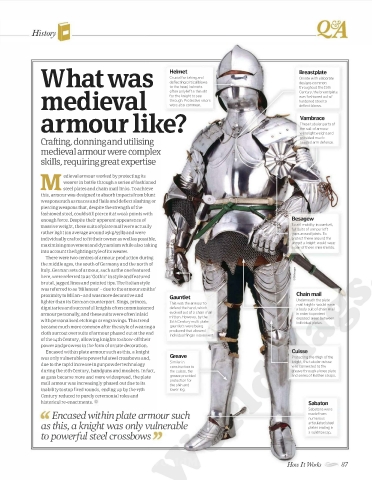
What was to the head, helmets Breastplate
Helmet
Crucial for taking and
Ornate with elaborate
deflecting critical blows
designs common
throughout the 15th
often only left a thin slit
medieval for the knight to see Century, the breastplate
was fashioned out of
through. Protective visors
hardened steel to
were also common.
deflect blows.
armour lil<e? These tubular parts of
the suit of armour
were lightweight and
Crafting, donning and utilising provided much
needed arm defence.
medieval armour were complex
skills, requiring great expertise
edieval armour worked by protecting its
wearer in battle through a series of fashioned
M steel plates and chain mail links. To achieve
this, armour was designed to absorb impacts from blunt
weapons such as maces and flails and deflect slashing or
piercing weapons that, despite the strength of the
fashioned steel, could still pierce it at weak points with
enough force. Despite their apparent appearance of
To aid mobility in combat,
massive weight, these suits of plate mail were actually
full suits of armour left
rather light (on average around 25kg/55lb) and were gaps around joints. To
individually crafted to fit their owner as well as possible, protect these around the
armpit a knight would wear
maximising movement and dynamism while also taking
a pair of these mini shields.
into account the fighting style of its wearer.
There were two centres of armour production during
the middle ages, the south of Germany and the north of
Italy. German sets of armour, such as the one featured
here, were referred to as 'Gothic' in style and featured
brutal, jagged lines and pointed tips. The Italian style
was referred to as 'Milanese' - due to the armour smiths'
proximity to Milan-and was more decorative and Gauntlet
lighter than its German counterpart. Kings, princes, This was the armour to Underneath the plate
mail knights would wear
dignitaries and successful knights often commissioned defend the hand, which a body suit of chain mail
armour personally, and these suits were often inlaid evolved out of a chain mail in order to protect
mitten. However, by the exposed areas between
with personalised etchings or engravings. This trend 15th Century multi-plate individual plates.
became much more common after the style of wearing a gauntlets were being
produced that allowed
cloth sur coat over suits of armour phased out at the end
individual finger movement.
of the 14th Century, allowing knights to show-off their
power and prowess in the form of ornate decoration.
Encased within plate armour such as this, a knight
was only vulnerable to powerful steel crossbows and, Greave Protecting the thigh of the
Similar in knight, the tubular cuisse
due to the rapid increase in gunpowder technology
construction to was connected to the
during the 16th Century, handguns and muskets. In fact, the cuisse, the greave through a knee plate
as guns became more and more widespread, the plate greave provided and series of leather straps.
protection for
mail armour was increasingly phased out due to its
the shin and
inability to stop fired rounds, ending up by the 17th lower leg.
Century reduced to purely ceremonial roles and
historical re-enactments. Sabat on
Sa batons were
Encased within plate armour such made from
numerous
as this, a knight was only vulnerable articulated steel
plates ending in
to powerful steel crossbows a solid toecap.
WorldMags.net
WorldMags.net How It T%rks 87

