


Page 86 - How It Works - Book of Amazing Answers To Curious Questions, 12
P. 86
� AMAZIG ANSWERS TO CURIOUS QUESTIONS
How did the 1698 1807
How old is stea powe
The first proficient commercial
Thomas Savery patents his steam boat was launched;
machine for the raising of water
first steam by the "impellent force of fire", Robert Fulton's North River
the first design of a steam pump.
Steamboat.
1712
Thomas Newcomen builds 1812
First commercial locomotive
engines worl<? It is erected near Dudley Castle Eight years later there were 20
the first practical steam engine.
constructed by Matthew Murray.
steam locomotives in service.
in Staffordshire.
1733
Savery's patent expires meaning 1827
Goldsworthy Gurney built a
more Newcomen engines could steam carriage to be used as a
For centuries the steam engine has been powering be built without infringement. vehicle on the roads, motoring
along at 15mph.
the British industry and even today steam plays a 1769-1800 1884
James Watt dominates steam-engine
design and improvement. The Watt The steam turbine replaced steam
big part in the generation of electridty. We take a steam engine was the first to use power in its previous form with
Charles Parson's axial-flow turbine.
steam at a pressure above
look at the men behind these major inventions atmospheric to drive the piston. 1918
1804 The end of the longest working
Arthur Woolf builds a compound atmospheric engine. Built by
ntil the start of the 18th Century, carriages to traction engines for the land engine that matches the work of Francis Thompson in 1791 it stood
machines were powered by muscle, and engine houses for grinding and Watt's machines using half the fuel. at Pentrich Colliery.
U water or wind, but steam power processing grain. 1806
provided the potential for growth and By 1820 steam locomotives were Richard Trevithick
flexibility on a mass scale. Steam engines commonplace and in 1830 'The Liverpool becomes the first
British engineer to use
facilitated the birth of large factories as and Manchester Railway' opened as high-pressure 'strong'
steam. The machine
production moved from rural riverbanks to the world's first inter-city passenger revolutionised
industrial towns, creating the formation of railway, engineered by George Stephenson transport.
the cities we know today. and utilising locomotives that were
Steam power had been around for designed by his son Robert, including the
generations but it wasn't until 1698 that its magnificent Rocket.
application into industry was made. Towards the end of the 19th Century
Military engineer Thomas Savery created a inventors found new ways to maximise
patent for raising of water by "the impellent steam efficiency and in 1884 Charles
force of fire", the first noted design of a Parson's steam turbines opened a whole
steam pump. In 1712 Thomas Newcomen new world of possibilities. Today steam
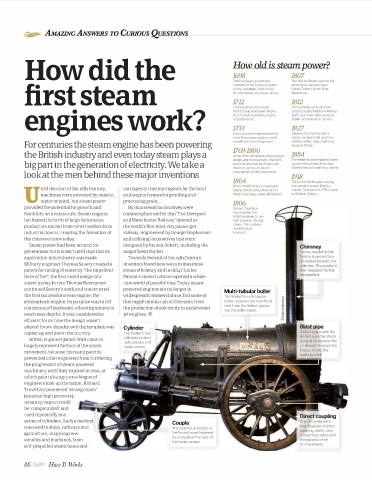
continued Savery's work and constructed powered engines are no longer in Multi-tubular boiler
the first successful steam engine, the widespread commercial use, but some of The Rocket's multi·tubular
atmospheric engine. lts purpose was to rid their applications can still be seen from boiler improves the transfer of
heat from the firebox gasses
coal mines of floodwater, allowing miners to the production of electricity to underwater
into the boiler water.
reach new depths. It was considered so jet engines.
efficient for its time the design wasn't
altered for six decades and the template was Cylinder
copied up and down the country. The Rocket's two
British engineer James Watt came to
largely represent the face of the steam
movement, because his many patents
prevented other engineers from furthering
the progression of steam-powered
machinery until they expired in 18oo, at
which point a hungry new league of
engineers took up the baton. Richard
Trevithick pioneered 'strong steam'
(steam at high pressure),
meaning vapour could
be 'compounded' and
used repeatedly in a
series of cylinders. Such a method
was used in ships, railways and Any coaches attached to main features is direct
coupling, which uses
agriculture, inspiring new the Rocket were fastened connecting rods to link
by a couple at the back of
vehicles and machines, from the steam engine. the pistons to the
self-propelled steam boats and driving wheels.
86 How It TtOrks WorldMags.net
WorldMags.net

