


Page 88 - How It Works - Book of Amazing Answers To Curious Questions, 12
P. 88
What's inside
HMS Victory?
One of the most famous ships of all time,
HMS Victory was crucial to ensuring
British naval supremacy during the
late 18th and early 19th centuries
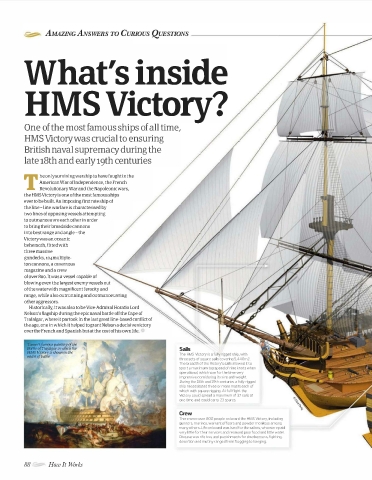
he only surviving warship to have fought in the
American War oflndependence, the French
T Revolutionary War and the Napoleonic wars,
the HMS Victory is one of the most famous ships
ever to be built. An imposing first rate ship of
the line -line warfare is characterised by
two lines of opposing vessels attempting
to outman oeuvre each other in order
to bring their broadside cannons
into best range and angle- the
Victory was an oceanic
behemoth, fitted with
three massive
gundecks, 104multiple
ton cannons, a cavernous
magazine and a crew
of over 8oo. It was a vessel capable of
blowing even the largest enemy vessels out
ofthewaterwith magnificent ferocity and
range, while also outrunning and outmanoeuvring
other aggressors.
Historically, it was also to be Vice-Admiral Horatio Lord
Nelson's flagship during the epic naval battle off the Cape of
Trafalgar, where it partook in the last great line-based conflict of
the age, one in which it helped to grant Nelson a decisive victory
over the French and Spanish but at the cost of his own life.
's famous painting of the
Battle ofTrafalgar in which the Sails
HMS Victory is shown in the The HMS Victory is a fully rigged ship, with
midst of battle
three sets of square sails covering 5,440m2.
The breadth of the Victory's sails allowed it to
sport a maximum top speed of nine knots when
operational, which was for the time very
impressive considering its size and weight.
During the 18th and 19th centuries a fully rigged
ship necessitated three or more masts each of
which with square rigging. At full flight the
Victory could spread a maximum of 37 sails at
one time and could carry 23 spares.
Crew
There were over 800 people on board the HMS Victory, including
gunners, marines, warrant officers and powder monkeys among
many others. Life on board was hard for the sailors, who were paid
very little for their services and received poor food and little water.
Disease was rife too, and punishments for drunkenness, fighting,
desertion and mutiny ranged from flogging to hanging.
88 How It TtOrks WorldMags.net
WorldMags.net

