


Page 22 - (DK Eyewitness) Travel Guide - Brittany
P. 22
20 INTRODUCING BRIT T AN Y
fishing, by contrast, has proved
more resistant to economic instability.
However, while the industry still involves
three-quar ters of Breton fishing vessels,
it has to contend with foreign imports,
falling prices, dwindling fish stocks,
industri al pollution, periodic oil spillages
and competition from fish farming.
The industry is now undergoing
reorgani zation in order to strengthen
Breton lace for sale at a market in Ste-Anne-d’Auray, its infrastructure.
in the Morbihan While fishing has been under threat
for some 50 years, agriculture, food
which had already been heavily crops and tourism underpin the region’s
exploited since Roman times. Only economy. Brittany is the foremost milk
10 per cent of Brittany’s primeval producer in France. It also provides a
forest remains today. quarter of the country’s livestock and
is a prime producer of fruit
A Diverse Economy and veg etables. Breton
Bretons have never been produce is marketed under
daunted by harsh natural such well-known brand
elements. They went as far as names as Saupiquet,
Newfoundland and Ice land Béghin-Say, Petit Navire,
during the peak deep-sea Paysans Bretons, Père Dodu
fishing years of the 19th and Hénaff (a famous pâté).
century, then, following the Manufacturing and the
collapse of that trade, turned Old advertising poster for ser vice industry are also
to factory ships, which Béghin-Say sugar well developed. One Breton
concentrated on the Atlantic in five works in manufacturing
coastlines of Africa, Morocco, Mauritania, or the build ing trade, while one in two
Senegal and South America. Local coastal works in retailing, the service industry or
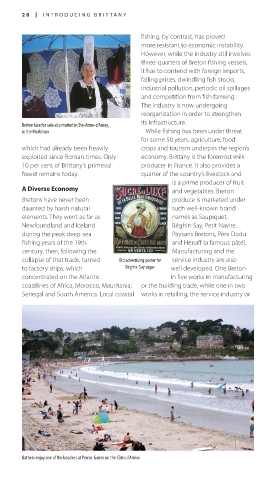
Bathers enjoy one of the beaches at Perros-Guirec on the Côtes d’Armor
018-021_EW_Brittany.indd 20 11/3/16 12:41 PM

