


Page 25 - (DK Eyewitness) Travel Guide - Brittany
P. 25
A POR TR AIT OF BRIT T AN Y 23
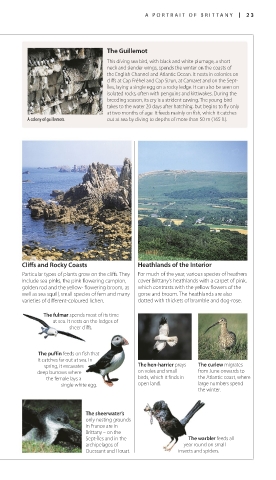
The Guillemot
This diving sea bird, with black and white plumage, a short
neck and slender wings, spends the winter on the coasts of
the English Channel and Atlantic Ocean. It nests in colonies on
cliffs at Cap Fréhel and Cap Sizun, at Camaret and on the Sept-
Îles, laying a single egg on a rocky ledge. It can also be seen on
isolated rocks, often with penguins and kittiwakes. During the
breed ing season, its cry is a strident cawing. The young bird
takes to the water 20 days after hatching, but begins to fly only
at two months of age. It feeds mainly on fish, which it catches
A colony of guillemots out at sea by diving to depths of more than 50 m (165 ft).
Cliffs and Rocky Coasts Heathlands of the Interior
Particular types of plants grow on the cliffs. They For much of the year, various species of heathers
include sea pinks, the pink-flowering campion, cover Brittany’s heathlands with a carpet of pink,
golden rod and the yellow- flower ing broom, as which contrasts with the yellow flowers of the
well as sea squill, small species of fern and many gorse and broom. The heathlands are also
varieties of different-coloured lichen. dotted with thickets of bramble and dog-rose.
The fulmar spends most of its time
at sea. It nests on the ledges of
sheer cliffs.
The puffin feeds on fish that
it catches far out at sea. In
spring, it excavates The hen-harrier preys The curlew migrates
deep bur rows where on voles and small from June onwards to
the female lays a birds, which it finds in the Atlantic coast, where
single white egg. open land. large numbers spend
the winter.
The sheerwater’s
only nesting grounds
in France are in
Brittany – on the
Sept-Îles and in the The warbler feeds all
archipelagos of year round on small
Ouessant and Houat. insects and spiders.
022-023_EW_Brittany.indd 23 11/3/16 1:01 PM

