


Page 26 - (DK Eyewitness) Travel Guide - Brittany
P. 26
24 INTRODUCING BRIT T AN Y
Rural Architecture
The scenic appeal of the Breton countryside owes
much to its picturesque old houses, which seem
to be fixed in time. Their appearance varies markedly
according to topogra phy, available materials and
local tra ditions. In Upper Brittany, houses were built
in rows, standing gable to gable so as to form
rectangular groups (longères). Typical of Lower
Brittany is the pennti, a more compact house, with
contiguous outbuildings, such as byres and coach
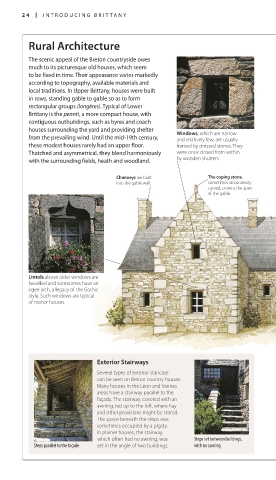
houses surrounding the yard and pro viding shelter Windows, which are narrow
from the prevailing wind. Until the mid-19th century, and relatively few, are usually
these modest houses rarely had an upper floor. framed by dressed stones. They
Thatched and asymmetrical, they blend harmoniously were once closed from within
with the surrounding fields, heath and woodland. by wooden shutters.
Chimneys are built The coping stone,
into the gable wall. sometimes decoratively
carved, crowns the apex
of the gable.
Lintels above older windows are
bevelled and sometimes have an
ogee arch, a legacy of the Gothic
style. Such windows are typical
of manor houses.
Exterior Stairways
Several types of exterior staircase
can be seen on Breton country houses.
Many houses in the Léon and Vannes
areas have a stairway parallel to the
façade. The stairway, covered with an
awning, led up to the loft, where hay
and other provisions might be stored.
The space beneath the steps was
sometimes occupied by a pigsty.
In plainer houses, the stairway,
which often had no awning, was Steps set between buildings,
Steps parallel to the façade set in the angle of two buildings. with no awning
024-025_EW_Brittany.indd 24 11/3/16 1:01 PM

