


Page 24 - (DK Eyewitness) Travel Guide - Brittany
P. 24
22 INTRODUCING BRIT T AN Y
Landscape and Birds of Brittany
Brittany attracts more sea birds than any other
coastal region of France. At the end of the summer,
birds that have nested in northern Europe begin to
appear on the coast of Brittany. While some species
continue on their southern migrations to spend the
winter in warmer climates, many stay in Brittany
until the early spring, when, together with birds
newly returned from the south, they fly north once
again to breed.
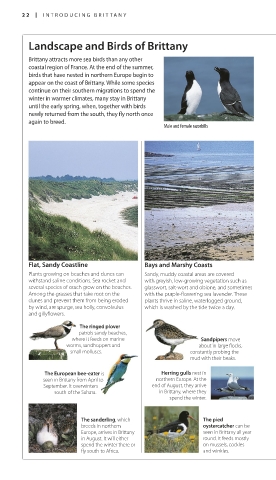
Male and female razorbills
Flat, Sandy Coastline Bays and Marshy Coasts
Plants growing on beaches and dunes can Sandy, muddy coastal areas are covered
withstand saline conditions. Sea rocket and with greyish, low-growing vegetation such as
several species of orach grow on the beaches. glasswort, salt-wort and obione, and some times
Among the grasses that take root on the with the purple-flowering sea lavender. These
dunes and prevent them from being eroded plants thrive in saline, waterlogged ground,
by wind, are spurge, sea holly, convolvulus which is washed by the tide twice a day.
and gillyflowers.
The ringed plover
patrols sandy beaches,
where it feeds on marine Sandpipers move
worms, sandhoppers and about in large flocks,
small molluscs. constantly probing the
mud with their beaks.
The European bee-eater is Herring gulls nest in
seen in Brittany from April to northern Europe. At the
September. It overwinters end of August, they arrive
south of the Sahara. in Brittany, where they
spend the winter.
The sanderling, which The pied
breeds in northern oystercatcher can be
Europe, arrives in Brittany seen in Brittany all year
in August. It will either round. It feeds mostly
spend the winter there or on mussels, cockles
fly south to Africa. and winkles.
022-023_EW_Brittany.indd 22 11/3/16 1:01 PM

