


Page 23 - (DK Eyewitness) Travel Guide - Brittany
P. 23
A POR TR AIT OF BRIT T AN Y 21
administration. High- The growth of high-tech
tech industries have establishments can seem
multiplied and many incongruous in this land
technological innova- of menhirs, Romanesque
tions have been devel- chapels, Gothic churches,
oped in the region. fortified castles, coastal
Brittany is also one of forts and 18th-century
the most popular manor houses. Since
tourist destinations Neolithic times, when
in France. menhirs were raised,
and cairns, megalithic
A Culture Revived monuments and other
Traditional Breton music passage graves were built,
underwent a major reli gion has imbued local
revival in the 1960s culture. Romanesque
thanks to Alan Stivell, churches appeared in
Kristen Noguès, Gilles the 11th and 12th cen turies,
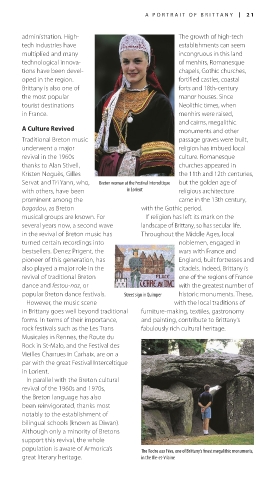
Servat and Tri Yann, who, Breton woman at the Festival Interceltique but the golden age of
with others, have been in Lorient religious architecture
promi nent among the came in the 13th century,
bagadou, as Breton with the Gothic period.
musical groups are known. For If religion has left its mark on the
sever al years now, a second wave landscape of Brittany, so has secular life.
in the revival of Breton music has Throughout the Middle Ages, local
turned certain recordings into noblemen, engaged in
bestsellers. Denez Prigent, the wars with France and
pioneer of this generation, has England, built fortresses and
also played a major role in the citadels. Indeed, Brittany is
revival of traditional Breton one of the regions of France
dance and festou-noz, or with the greatest number of
popular Breton dance festivals. Street sign in Quimper his toric monuments. These,
However, the music scene with the local traditions of
in Brittany goes well beyond traditional furniture-making, textiles, gastronomy
forms. In terms of their importance, and painting, contribute to Brittany’s
rock festivals such as the Les Trans fabulously rich cultural heritage.
Musicales in Rennes, the Route du
Rock in St-Malo, and the Festival des
Vieilles Charrues in Carhaix, are on a
par with the great Festival Interceltique
in Lorient.
In parallel with the Breton cultural
revival of the 1960s and 1970s,
the Breton language has also
been re invigorated, thanks most
notably to the establishment of
bilingual schools (known as Diwan).
Although only a minority of Bretons
support this revival, the whole
population is aware of Armorica’s The Roche aux Fées, one of Brittany’s finest megalithic monuments,
great literary heritage. in the Ille-et-Vilaine
018-021_EW_Brittany.indd 21 11/3/16 12:41 PM

