


Page 50 - (DK Eyewitness) Travel Guide - Brittany
P. 50
48 introducing brit t an y
Anne of Brittany
a central figure in the history of brittany, anne stood
both for the duchy’s independence and, through her
marriage first to charles Viii and then to Louis Xii – both
of them kings of France – for its integration with France.
the vissicitudes of her short and eventful life also made
her popular. She became a duchess at the age of 11, a
queen at 13, a mother at 16, and a widow at 21. She died Anne of Brittany’s coat of arms
at the age of 37, having lost seven of her nine children. feature a Franciscan nun, an ermine
Even today, some bretons revere her almost as a saint. and the motto “To my Life.”
a patron of the arts, she aided the development of
breton culture by supporting artists and historians.
Jean de Rely, bishop of Angers.
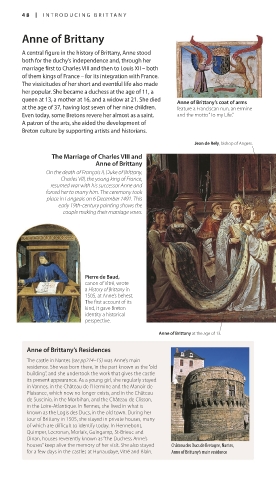
The Marriage of Charles VIII and
Anne of Brittany
On the death of François II, Duke of Brittany,
Charles VIII, the young king of France,
resumed war with his successor Anne and
forced her to marry him. The ceremony took
place in Langeais on 6 December 1491. This
early 19th-century painting shows the
couple making their marriage vows.
Pierre de Baud,
canon of Vitré, wrote
a History of Brittany in
1505, at Anne’s behest.
The first account of its
kind, it gave Breton
identity a historical
perspective.
Anne of Brittany at the age of 13.
Anne of Brittany’s Residences
The castle in Nantes (see pp214–15) was Anne’s main
residence. She was born there, in the part known as the “old
building”, and she undertook the work that gives the castle
its present appearance. As a young girl, she regularly stayed
in Vannes, in the Château de l’Hermine and the Manoir de
Plaisance, which now no longer exists, and in the Château
de Suscinio, in the Morbihan, and the Château de Clisson,
in the Loire-Atlantique. In Rennes, she lived in what is
known as the Logis des Ducs, in the old town. During her
tour of Brittany in 1505, she stayed in private houses, many
of which are difficult to identify today. In Hennebont,
Quimper, Locronan, Morlaix, Guingamp, St-Brieuc and
Dinan, houses reverently known as “the Duchess Anne’s
houses” keep alive the memory of her visit. She also stayed Château des Ducs de Bretagne, Nantes,
for a few days in the castles at Hunaudaye, Vitré and Blain. Anne of Brittany’s main residence
BT_48-49-AT996-HISTS.indd 48 17/12/14 4:49 pm

