


Page 53 - (DK Eyewitness) Travel Guide - Brittany
P. 53
A HIST OR Y OF BRIT T AN Y 51
printed paper used for legal documents
caused a revolt in Lower Brittany in
1675. The harsh repression that followed
was described by Madame de Sévigné
(see p73).
In 1689, so that his decisions might be
more effectively implemented, Louis XIV
placed the province under the control of
an intendant, whose remit was to impose
law and order and collect taxes. These
mea sures caused a resurgence of Breton
nationalism, most strongly among the
petty nobility, that continued until the Henri IV on a military campaign against partisans of the Holy
end of the Ancien Régime. League, a group of Catholic extremists, in Brittany in 1598
Much more troublesome for royal rule
was legal opposition mounted against the commander-in-chief of Brittany. The “Breton
intendant and the governor led by the question” enflamed the province and did
States of Brittany and the Breton not die down until the death of Louis XV,
parliament. While the States claimed to in 1774.
defend Breton autonomy, they in fact
supported the interests of the nobility. Brittany’s Thriving Ports
From 1759 to 1770, tensions ran high, Under the Ancien Régime, Brittany
reaching a climax in the conflict between experienced vigorous economic growth.
Louis-René de Caradeuc de La Chalotais, Port activity prospered as a result both of
the Breton parliament’s ambitious and Brittany’s integration with France and of the
popular procurator-general, and the Duke opening of sea routes across the Atlantic.
of Aiguillon, the authoritarian and efficient Brittany played its part in voyages of
discovery with the expedition to Canada
undertaken by Jacques Cartier, of St-Malo,
(1534–42). The three busiest French
seaports were St-Malo, Nantes and Lorient,
built in 1666 as a base for the French East
India Company. Conflict between France
and England interfered with economic
activity on the coasts, as the English
launched attacks on St-Malo, Belle-Île and
St-Cast. Naval warfare also led to Colbert’s
building an arsenal at Brest (c. 1680), while
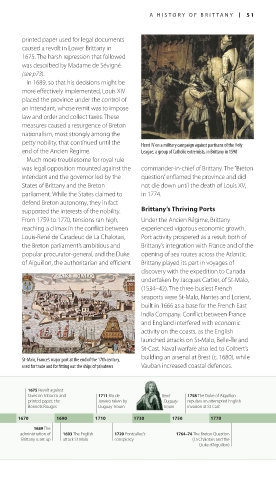
St-Malo, France’s major port at the end of the 17th century,
used for trade and for fitting out the ships of privateers Vauban increased coastal defences.
1675 Revolt against
taxes on tobacco and 1711 Rio de René 1758 The Duke of Aiguillon
printed paper; the Janeiro taken by Duguay- repulses an attempted English
Bonnets Rouges Duguay-Trouin Trouin invasion at St-Cast
1650 1670 1690 1710 1730 1750 1770
1689 The
administration of 1693 The English 1720 Pontcallec’s 1764–74 The Breton Question
Brittany is set up attack St-Malo conspiracy (La Chalotais and the
Duke d’Aiguillon)
050-053_EW_Brittany.indd 51 11/3/16 1:02 PM

