


Page 55 - (DK Eyewitness) Travel Guide - Brittany
P. 55
A HIST OR Y OF BRIT T AN Y 53
traditions and ancient tales. ports, including St-Nazaire, Lorient,
The Breton language, strongly Brest and St-Malo, were razed by
discouraged in undenominational fighting during the Liberation.
schools during the Third Republic
(1870–1940), found ardent Brittany in the Modern World
supporters among the clergy, Brittany made a remarkable recovery
while regional history became after World War II. Since 1950, the
the object of renewed interest, Comité d’Étude et de Liaison des
culminating in La Borderie’s Intérêts Bretons has attracted
monumental History of Brittany. investment and such decentralized
Strong cultural regionalism operations as that of PSA in Rennes
asserted itself around 1900, with and telecommunications in Lannion.
the Union Régionaliste Bretonne, Toll-free highways, high-speed train
followed by the formation of the services and the installation of
Parti National Breton, which was airports have ended Brittany’s
supported by the occupying isolation. Cross-channel links and
Germans in 1940–44. Poster for the inauguration a strong hotel industry make it
of the Paris-Brest railway
In the 19th century, the second-most popular tourist
continuing high birth rates and the destination in France.
absence of industry caused large-scale Brittany is also France’s foremost producer
rural emigration to Paris, where a vigorous of fruit and vegetables, and a leading
Breton community became established. producer of pigs and chickens. Such
Bretons became prominent on the success has its price: farmers are crippled
national stage. Among them were by the cost of modern equipment and soil
Chateaubriand, politician and writer of the is overloaded with nitrate. The region’s
Romantic age; René Pléven, a minister problems are now being addressed: the
during the Fourth Republic; Félicité de need to preserve places of historic interest
Lamennais, a founder of social Catholicism; and natural beauty is seen as a priority, as is
and the religious sceptic Ernest Renan. the importance of keeping alive Brittany’s
With the arrival of the railway in the mid- links with other Celtic regions in Europe.
19th century, Brittany began to attract
writers and artists, drawn by the wild
beauty of its countryside and the exotic
nature of its Celtic traditions.
Brittany suffered greatly during the two
world wars: in 1914–18, the proportion of
Breton soldiers killed was twice the national
average. In 1940–45, the region was
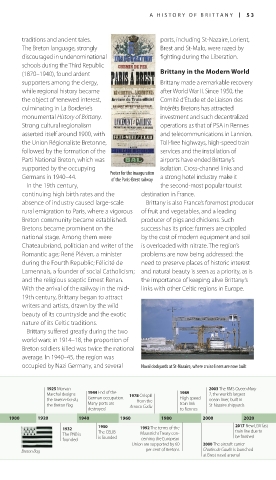
occupied by Nazi Germany, and several Naval dockyards at St-Nazaire, where cruise liners are now built
1925 Morvan 2003 The RMS Queen Mary
1898 Marchal designs 1944 End of the 1989 2, the world’s largest
The URB is the Gwenn-ha-du, German occupa tion. 1978 Oil spill High-speed- ocean liner, built in
founded the Breton flag Many ports are from the train link St-Nazaire shipyards
destroyed Amoco Cadiz to Rennes
1880 1900 1920 1940 1960 1980 2000 2020
1950 2017 New LGV fast
1932 1992 The terms of the train line due to
The PNB is The CELIB Maastricht Treaty con- be finished
founded is founded cerning the European
Union are supported by 60 2000 The aircraft carrier
Breton flag per cent of Bretons Charles de Gaulle is launched
at Brest naval arsenal
050-053_EW_Brittany.indd 53 11/3/16 1:02 PM

