


Page 52 - (DK Eyewitness) Travel Guide - Brittany
P. 52
50 INTRODUCING BRIT T AN Y
delegates agreed with the king the level
of taxation to be levied on the province.
Brittany paid lower taxes than the rest of the
kingdom and was exempt from the salt tax.
Parliament, restored in 1554, was housed
in a suitably imposing building in Rennes
dating from 1618–55 (see pp66–7).
Parliament was the supreme court of
Breton law and was also a court in which
royal decrees became statute. Brittany was
thus able to retain its own legal system.
In the 16th century, Brittany was largely
unaffected by the Wars of Religion fought
between Catholics and Protestants. Strongly
Catholic, it contained only a small number of
Calvinists. However, under Henri IV, king of
France and governor of Brittany, was the
ambitious Philippe-Emmanuel de Lorraine,
Map of Brittany in 1595, at the time of the wars of the
Holy League Duke of Mercœur. One of the mainstays of
the Holy League – a group of Catholic
Brittany Joins France extremists – he attempted to harness the
Brittany’s integration into the kingdom of loyalty of Bretons to Rome so as to draw
France made no fundamental difference to them into a war against the heretical king,
the lives of Bretons. The Treaty of Union of and lured them with thoughts of inde-
1532 ensured that their “rights, freedoms pendence. After ten years of conflict, from
and privileges” would be respected. The 1589 to 1598, Mercœur was forced to
province was ruled on behalf of the withdraw, and, in Nantes, Henri IV
king by a governor, who usually signed the Edict of Nantes,
had connections with the ending the Wars of Religion.
great Breton families. The
interests of the population Resistance to
were, in principle, defended the Monarchy
by the States of Brittany, an In the 17th century, royal
assembly that was, how ever, power became absolute,
unrepresentative, since the and the monarchy in France
rural population had no developed centralized rule.
delegate. The nobility and Local auto nomy was curtailed
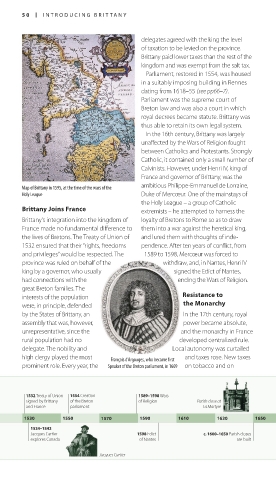
high clergy played the most François d’Argouges, who became first and taxes rose. New taxes
prominent role. Every year, the Speaker of the Breton parliament, in 1669 on tobacco and on
1532 Treaty of Union 1554 Creation 1589–1598 Wars
signed by Brittany of the Breton of Religion Parish close at
and France parliament La Martyre
1530 1550 1570 1590 1610 1630 1650
1534–1542
Jacques Cartier 1598 Edict c. 1600–1650 Parish closes
explores Canada of Nantes are built
Jacques Cartier
050-053_EW_Brittany.indd 50 11/3/16 1:02 PM

