


Page 77 - BBC Wildlife Volume 36 #05
P. 77
ROTHSCHILD AT 150


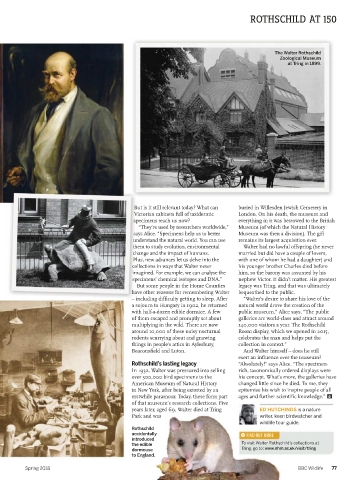
                                                                                              The Walter Rothschild
                                                                                                Zoological Museum
                                                                                                  at Tring in 1899.


                                              B
                                              But is it still relevant today? What can  buried in Willesden Jewish Cemetery in
                                              V
                                              Victorian cabinets full of taxidermic  London. On his death, the museum and
                                              s pecimens teach us now?            everything in it was bestowed to the British
                                                “They’re used by researchers worldwide,”  Museum (of which the Natural History
                                              s ays Alice. “Specimens help us to better  Museum was then a division). The gift
                                              u
                                              understand the natural world. You can use  remains its largest acquisition ever.
                                              th                                   Walter had no lawful offspring (he never
                                               hem to study evolution, environmental
                                              ch                                  married but did have a couple of lovers,
                                               hange and the impact of humans.
                                              P lus, new advances let us delve into the  with one of whom he had a daughter) and
                                              co ollections in ways that Walter never  his younger brother Charles died before
                                              im                                  him, so the barony was assumed by his
                                              magined. For example, we can analyse the
                                               pecimens’ chemical isotopes and DNA.”
                                              sp                                  nephew Victor. It didn’t matter. His greatest
                                               But some people in the Home Counties  legacy was Tring, and that was ultimately
                                              ha ave other reasons for remembering Walter  bequeathed to the public.
                                              – including difficulty getting to sleep. After  “Walter’s desire to share his love of the
                                              a sojourn to Hungary in 1902, he returned  natural world drove the creation of the
                                              with half-a-dozen edible dormice. A few  public museum,” Alice says. “The public
                                              of them escaped and promptly set about  galleries are world-class and attract around
                                              multiplying in the wild. There are now  140,000 visitors a year. The Rothschild
                                              around 10,000 of these noisy nocturnal  Room display, which we opened in 2015,
                                              rodents scurrying about and gnawing  celebrates the man and helps put the
                                              things in people’s attics in Aylesbury,  collection in context.”
                                              Beaconsfield and Luton.               And Walter himself – does he still
                                                                                  exert an influence over the museum?
                                              Rothschild’s lasting legacy         “Absolutely!” says Alice. “The specimen-
                                              In 1932, Walter was pressured into selling  rich, taxonomically ordered displays were
                                              over 300,000 bird specimens to the  his concept. What’s more, the galleries have
                                              American Museum of Natural History  changed little since he died. To me, they
                                              in New York, after being extorted by an  epitomise his wish to inspire people of all
                                              erstwhile paramour. Today, these form part  ages and further scientific knowledge.”
                                              of that museum’s research collections. Five
                                                                  di d t T i
                                                             W lt
                                                         d 6
                                              years l t ater, aged 69, Walter died at Tring   ED HUTCHINGS is a nature
                                              Park and was                               writer, keen  birdwatcher and
                                                                                         wildlife tour  guide.
                                                  c
                                              Rothschild
                                              accidentally                        +  FIND OUT MORE
                                                  n
                                              introduuced
                                              the edible                           To visit Walter Rothschild’s collections at
                                              dormouse                             Tring, go to: www.nhm.ac.uk/visit/tring
                                              to England.
          Spring 2018                                                                                 BBC Wildlife  77

