


Page 274 - (DK Eyewitness) Travel Guide - The Netherlands
P. 274
272 NOR THERN AND EASTERN NE THERLANDS
Birds of the Waddenzee
The extensive wetlands of the Waddenzee are an
important area for breeding and migratory birds. The
North Sea coasts of the islands are sandy, with little
animal life; the Waddenzee coasts of the islands,
however, consist of fine sand and clay which are rich
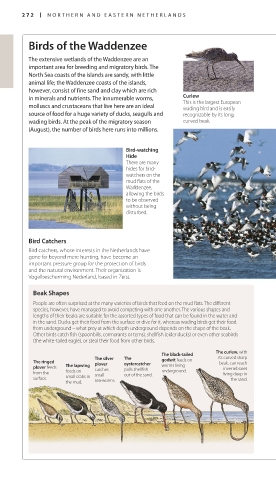
in minerals and nutrients. The innumerable worms, Curlew
This is the largest European
molluscs and crustaceans that live here are an ideal wading bird and is easily
source of food for a huge variety of ducks, seagulls and recognizable by its long,
wading birds. At the peak of the migratory season curved beak.
(August), the number of birds here runs into millions.
Bird-watching
Hide
There are many
hides for bird-
watchers on the
mud flats of the
Waddenzee,
allowing the birds
to be observed
without being
disturbed.
Bird Catchers
Bird catchers, whose interests in the Netherlands have
gone far beyond mere hunting, have become an
important pressure group for the protection of birds
and the natural environment. Their organization is
Vogelbescherming Nederland, based in Zeist.
Beak Shapes
People are often surprised at the many varieties of birds that feed on the mud flats. The different
species, however, have managed to avoid competing with one another. The various shapes and
lengths of their beaks are suitable for the assorted types of food that can be found in the water and
in the sand. Ducks get their food from the surface or dive for it, whereas wading birds get their food
from underground – what prey at which depth underground depends on the shape of the beak.
Other birds catch fish (spoonbills, cormorants or terns), shellfish (eider ducks) or even other seabirds
(the white-tailed eagle), or steal their food from other birds.
The curlew, with
The black-tailed
The silver The godwit feeds on its curved sharp
The ringed plover oystercatcher beak, can reach
plover feeds The lapwing catches pulls shellfish worms living invertebrates
from the feeds on small out of the sand. underground. living deep in
surface. small crabs in sea-worms. the sand.
the mud.
272-273_EW_Netherlands.indd 272 16/01/17 12:05 pm

