


Page 34 - (DK Eyewitness) Travel Guide - The Netherlands
P. 34
32 INTRODUCING THE NE THERLANDS
Pottery and Tiles
When in 1620 exports of porcelain from China to Europe fell
because of the troubles in China, Dutch potters seized the
opportunity and started to produce their own wares, imitating
the Chinese style on a large scale. The quality of the Dutch blue-
white pottery was excellent. The city of Delft became one of the
prime centres for the production of this china, which reached its
height between 1660 and 1725. During the Art Nouveau and
Art Deco periods, Dutch potters regained their international
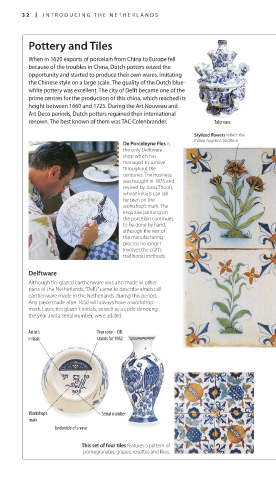
renown. The best known of them was TAC Colenbrander. Tulip vase
Stylized flowers reflect the
Italian majolica tradition.
De Porceleyne Fles is
the only Delftware
shop which has
managed to survive
throughout the
centuries. The business
was bought in 1876 and
revived by Joost Thooft,
whose initials can still
be seen on the
workshop’s mark. The
exquisite painting on
the porcelain continues
to be done by hand,
although the rest of
the manufacturing
process no longer
involves the craft’s
traditional methods.
Delftware
Although tin-glazed earthenware was also made in other
parts of the Netherlands, “Delft” came to describe almost all
earthenware made in the Netherlands during this period.
Any piece made after 1650 will always have a workshop
mark. Later, the glazer’s initials, as well as a code denoting
the year and a serial number, were added.
Artist’s Year code – DB
initials stands for 1982
Workshop’s Serial number
mark
Underside of a vase
This set of four tiles features a pattern of
pomegranates, grapes, rosettes and lilies.
032-033_EW_Netherlands.indd 32 16/01/17 12:02 pm
Eyewitness Travel LAYERS PRINTED:
Feature template “UK” LAYER
(SourceReport v1.3)
Date 18th October 2012
Size 125mm x 217mm

