


Page 31 - (DK Eyewitness) Travel Guide - The Netherlands
P. 31
A POR TR AIT OF THE NE THERLANDS 29
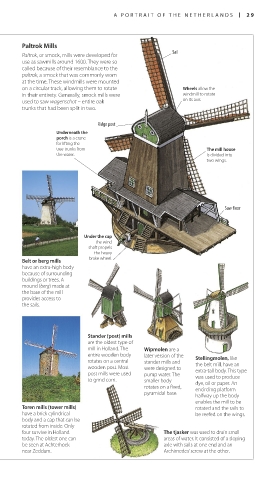
Paltrok Mills
Sail
Paltrok, or smock, mills were developed for
use as sawmills around 1600. They were so
called because of their resemblance to the
paltrok, a smock that was commonly worn
at the time. These windmills were mounted
on a circular track, allowing them to rotate Wheels allow the
in their entirety. Generally, smock mills were windmill to rotate
used to saw wagenschot – entire oak on its axis.
trunks that had been split in two.
Ridge post
Underneath the
porch is a crane
for lifting the
tree trunks from The mill house
the water. is divided into
two wings.
Cattle shed
Saw floor
Under the cap
the wind
shaft propels
the heavy
Belt or berg mills brake wheel.
have an extra-high body
because of surrounding
buildings or trees. A
mound (berg) made at
the base of the mill
provides access to
the sails.
Stander (post) mills
are the oldest type of
mill in Holland. The Wipmolen are a
entire wooden body later version of the Stellingmolen, like
rotates on a central stander mills and the belt mill, have an
wooden post. Most were designed to extra-tall body. This type
post mills were used pump water. The was used to produce
to grind corn. smaller body dye, oil or paper. An
rotates on a fixed, encircling platform
Langgevel (long-gable) pyramidal base. halfway up the body
farmhouses are common on enables the mill to be
the sandy ground of Peel Toren mills (tower mills) rotated and the sails to
and Kempen. In this have a brick cylindrical be reefed on the wings.
type of farmhouse, body and a cap that can be
the living rotated from inside. Only
accommodation four survive in Holland The tjasker was used to drain small
and farm today. The oldest one can areas of water. It consisted of a sloping
buildings are be seen at Achterhoek axle with sails at one end and an
arranged in a row. near Zeddam. Archimedes’ screw at the other.
028-029_EW_Netherlands.indd 29 16/01/17 12:02 pm

